Tailoring feels different from most WoW Classic professions because you gather its main material while simply playing the game.
Humanoid mobs drop cloth as you quest, grind, or run dungeons, so the profession fits naturally into normal leveling.
This tailoring guide classic will help you understand the cleanest path from early cloth recipes to stronger armor, bags, trainers, and useful late game crafts.
You will also see why Tailoring works so well for cloth classes, while still offering value to any player who wants more bag space.
Before you start buying stacks or crafting random bolts, let us first look at what Tailoring actually does and who benefits from it most.
What is Tailoring in WoW Classic and Who Should Take It?
Tailoring in WoW Classic is the profession for crafting cloth armor and bags. Unlike most crafting professions, it doesn’t require a gathering skill, because cloth drops naturally from humanoid mobs as you play.
That makes leveling Tailoring faster and cheaper to manage than professions built around a dedicated farming loop. That ease of access is what sets Tailoring apart.
Mining and Herbalism both need a gathering skill to supply materials. With Tailoring, you’re already collecting what you need just by questing and grinding through normal gameplay.
Tailoring is ideal for cloth-wearing classes like Mages, Warlocks, and Priests working through their own leveling path, since they get the most direct benefit from the armor it produces.
Bags are craftable too, which gives every character a practical reason to consider it.
Even if you don’t wear cloth yourself, Tailoring stays useful for the extra bag space and the free second profession slot.
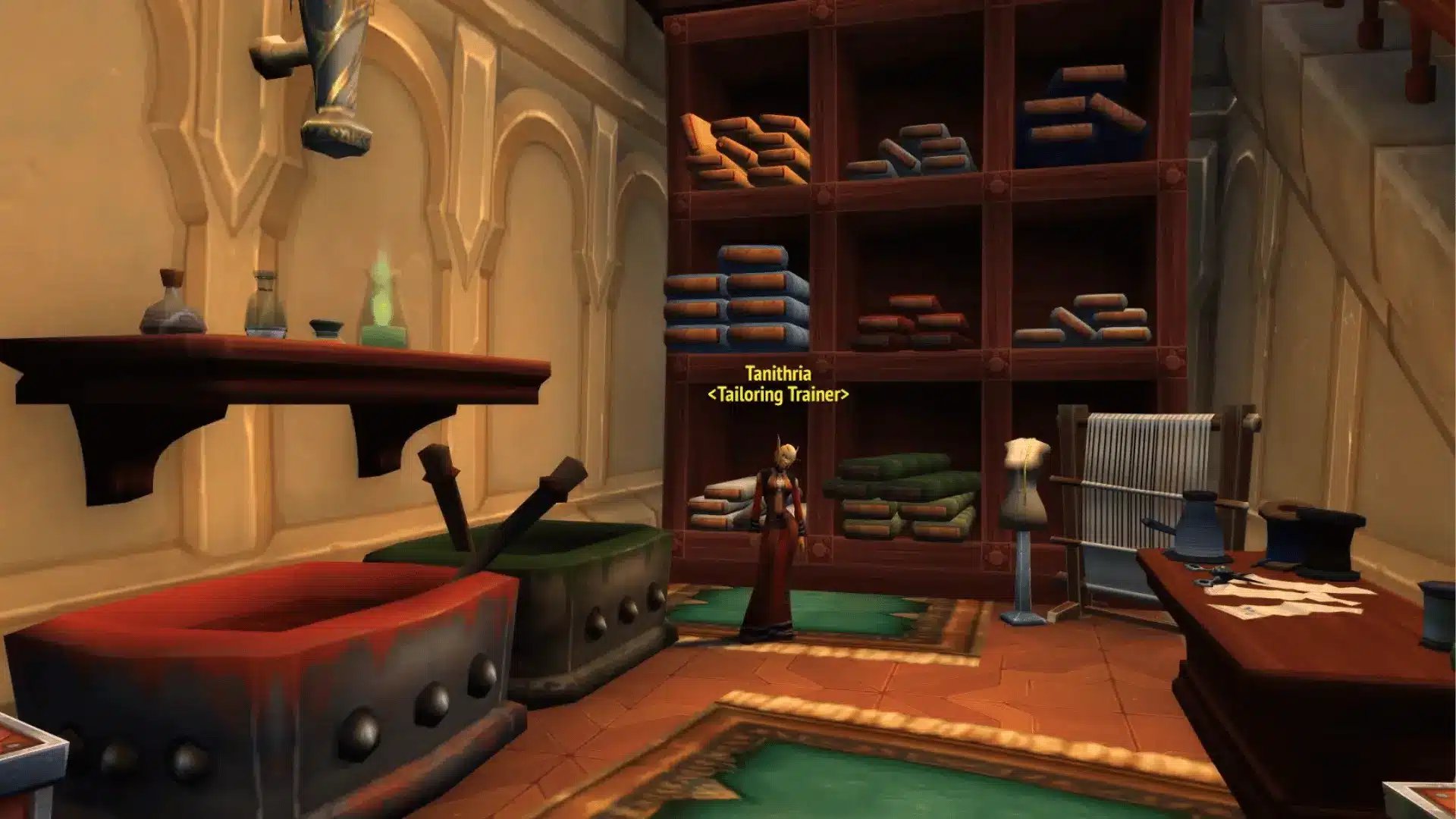
Where to Train Tailoring in WoW Classic (All Rank Gates)?
Classic Tailoring has four training ranks: Apprentice, Journeyman, Expert, and Artisan, and each one gates the skill range ahead of it.
Missing a rank halts skill progress without warning, so knowing where each one unlocks matters more than any single recipe choice.
Apprentice and Journeyman are easy to train, with trainers in every major city, but Expert and Artisan are the ranks that trip people up, since only a couple of named trainers teach them anywhere in the world.
| Rank | Skill Range | Requirements | Alliance Trainer | Horde Trainer |
|---|---|---|---|---|
| Apprentice | 1–75 | Character level 5 | Any Tailoring trainer in major cities | Any Tailoring trainer in major cities |
| Journeyman | 75–150 | Character level 10 | Any Tailoring trainer in major cities | Any Tailoring trainer in major cities |
| Expert | 150–225 | Level 20, 125 Tailoring skill | Georgio Bolero (Stormwind) | Josef Gregorian (Undercity) |
| Artisan | 225–300 | Level 35, 200 Tailoring skill | Timothy Worthington (Theramore Isle) | Daryl Stack (Tarren Mill) |
Alliance Trainer Locations
Apprentice and Journeyman Tailoring trainers are available in Stormwind, Ironforge, and Darnassus. Georgio Bolero in Stormwind’s Mage Quarter at Duncan’s Textiles teaches Expert Tailoring.
For Artisan Tailoring, Alliance players should visit Timothy Worthington in Theramore Isle (Dustwallow Marsh).
Horde Trainer Locations
Apprentice and Journeyman Tailoring trainers are available in Orgrimmar, Undercity, and Thunder Bluff. Josef Gregorian in Undercity teaches Expert Tailoring.
For Artisan Tailoring, Horde players should visit Daryl Stack in Tarren Mill (Hillsbrad Foothills).
Full Materials List for 1–300 (What to Farm or Buy Before You Start)
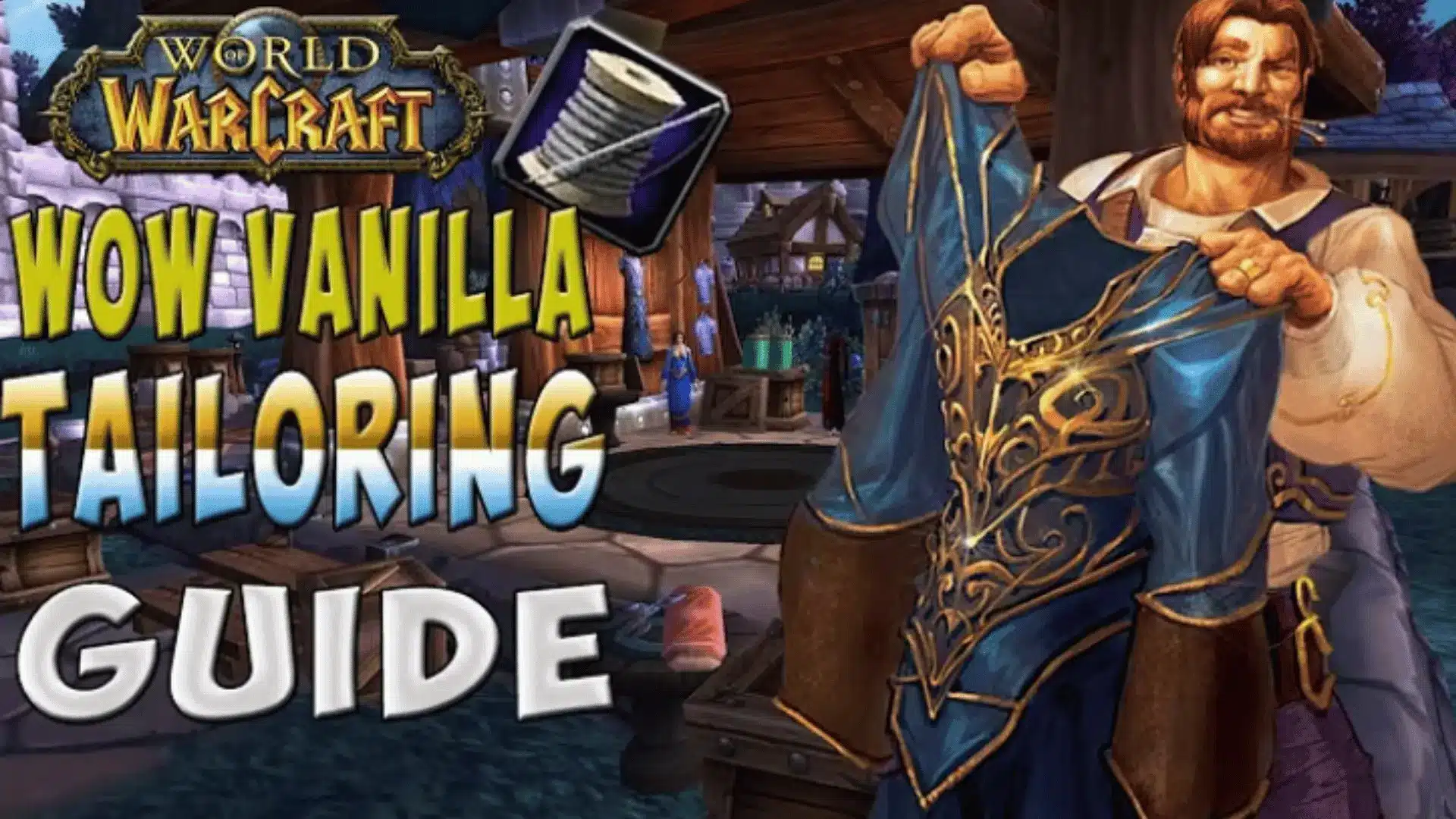
The biggest time-saver in Tailoring is having all materials ready before you start leveling.
Stopping to farm cloth or check the Auction House mid-session breaks your momentum more than it does for most other professions.
This tailoring leveling guide classic keeps every material on one list, so you’re not hunting for numbers mid-level.
- Linen Cloth: 180–200 pieces
- Wool Cloth: 130–150 pieces
- Silk Cloth: 780–850 pieces
- Mageweave Cloth: 480–520 pieces
- Runecloth: 750–820 pieces
- Rugged Leather: 90–100 pieces (needed late, for Runecloth Gloves)
- Coarse Thread: 35–45 pieces (vendor purchased)
- Fine Thread: 120–140 pieces (vendor purchased)
- Silken Thread: 15–25 pieces (vendor purchased)
- Heavy Silken Thread: 70–80 pieces (vendor purchased)
- Dyes (blue, red, orange) and a little bleach: a small stack of each, all vendor purchased
Thread and dye are bought from trade goods vendors near any Tailoring trainer, and enough recipes require them that skipping a supply run stalls you fast.
Quantities are given as ranges because skill-up rates vary, with the upper end providing a buffer against bad luck on yellow recipes near the top of a bracket.
When buying from the Auction House, factor in realm-specific pricing, as costs differ between servers and patch states.
Runecloth is often underestimated; that final stretch moves slower than earlier stages, and running short forces a stop at the worst moment, so buy more than you think you need.
Where to Farm Each Cloth Type?
If you’d rather farm than buy, each cloth tier maps cleanly to a level bracket of mobs.
- Linen Cloth drops from low-level humanoids in starting zones. Westfall and The Barrens are reliable for both factions, with dense mob populations and short respawn timers.
- Wool Cloth comes from mobs in the 20–30 range. Redridge Mountains and Hillsbrad Foothills work well for the Alliance. Thousand Needles and Hillsbrad cover the Horde.
- Silk Cloth drops reliably in the 30–40 bracket. Scarlet Monastery is the standout option, giving silk fast while also running a dungeon worth doing. Alterac Mountains is a solid open-world alternative.
- Mageweave Cloth comes from 40–50 humanoids. Tanaris and the Badlands both have strong humanoid density. Zul’Farrak drops it in quantity if you’re running dungeons.
- Runecloth is a 50–60 material. Western Plaguelands and Eastern Plaguelands are the most efficient farms, as undead and Scarlet Crusade mobs drop it consistently. Stratholme is the dungeon option if you want to combine farming with progression.
Farming your own cloth takes longer upfront but removes Auction House dependency entirely. If your realm has inflated cloth prices, the Runecloth bracket is usually where I tell people to just grit through the farming instead of buying, since that’s the tier where prices spike hardest.
The 1–300 Leveling Path (Recipes, Skill Brackets, and Why the Order Matters)
Most Tailoring guides just give a recipe list, but they don’t explain why the path matters. Understanding it helps when materials run short or prices change.
Recipes have difficulty with colors: orange, yellow, green, or grey. Orange almost always gives a skill-up, yellow drops as you near the ceiling, green is low, and grey gives none.
Following the path keeps you in orange or early yellow to maximize skill gains efficiently.
1. Skill 1–75 (Linen Bracket)
Start with Linen Cloth recipes from your trainer. Bolt of Linen Cloth takes you to around skill 30, then switch to Brown Linen Robe or White Linen Shirt to reach 75.
Both recipes stay orange long enough for efficient leveling, but the robe requires Coarse Thread, so make sure you have vendor thread ready.
Aim to hit 75 before running out of linen. If you’re short on cloth near the end, craft a few extra bolts, they remain yellow at this stage and still grant skill-ups without slowing progress.
2. Skill 75–150 (Wool Bracket)
Train Journeyman Tailoring at skill 50 if you haven’t yet. Bolt of Woolen Cloth carries you into the early 100s.
Once bolts turn yellow, switch to Double-stitched Woolen Shoulders or Woolen Cape to stay in the orange range longer. The 130–150 stretch slows down.
Gray Woolen Shirt is reliable here, staying yellow longer than alternatives while using materials you already have. It’s not glamorous, but it keeps leveling steadily and efficiently.
3. Skill 150–225 (Silk Bracket)
Train Expert Tailoring before reaching 150 to avoid capping out. A bolt of silk cloth gets you started. Around skill 160, switch to Silk Headband or Azure Silk Hood, which remain orange well into the 180s.
Mageweave recipes start entering the picture here too, from around skill 175 onward, well before Artisan Tailoring comes into play.
Crimson Silk Vest and Crimson Silk Pantaloons carry you toward 225. Expect yellow-range variance; skill-ups feel inconsistent near the top.
Stock extra silk before this stretch to avoid stopping mid-grind.
4. Skill 225–300 (Runecloth and the Final Push)
Train Artisan Tailoring once you hit skill 200 and character level 35, so you’re ready before you cap out at 225.
Continue any remaining Mageweave recipes, then transition into Runecloth around skill 250 to 260.
Bolt of Runecloth stays useful into the 270s, with Runecloth Belt and Runecloth Gloves offering good longevity and Auction House value through the final stretch to 300, which is the slowest part of the whole climb.
What About Mooncloth? The Recipe Most Guides Skip
Somewhere around skill 250, your Artisan trainer teaches a pattern that a lot of 1–300 leveling guides skip over entirely: Mooncloth. It’s not something you farm off mobs.
You transmute 2 Felcloth into a single piece at a Moonwell, and that transmutation carries a four-day cooldown no matter how many characters or Moonwells you have access to.
Mooncloth won’t help you level Tailoring itself, since you can’t spam it the way you can Bolt of Runecloth.
What it does is gate access to some of the profession’s best rewards.
Robe of the Archmage, Truefaith Vestments, and the Bottomless Bag all call for multiple pieces, which means weeks of banked cooldowns rather than a single grinding session.
If one of those items is on your endgame list, start banking Mooncloth the moment you hit skill 250, whether or not you’ve finished leveling the rest of the profession.
Waiting on a four-day cooldown for something I could otherwise just farm in an afternoon is the kind of grind that still gets to me, math background or not.
Best Professions to Pair With Tailoring in WoW Classic
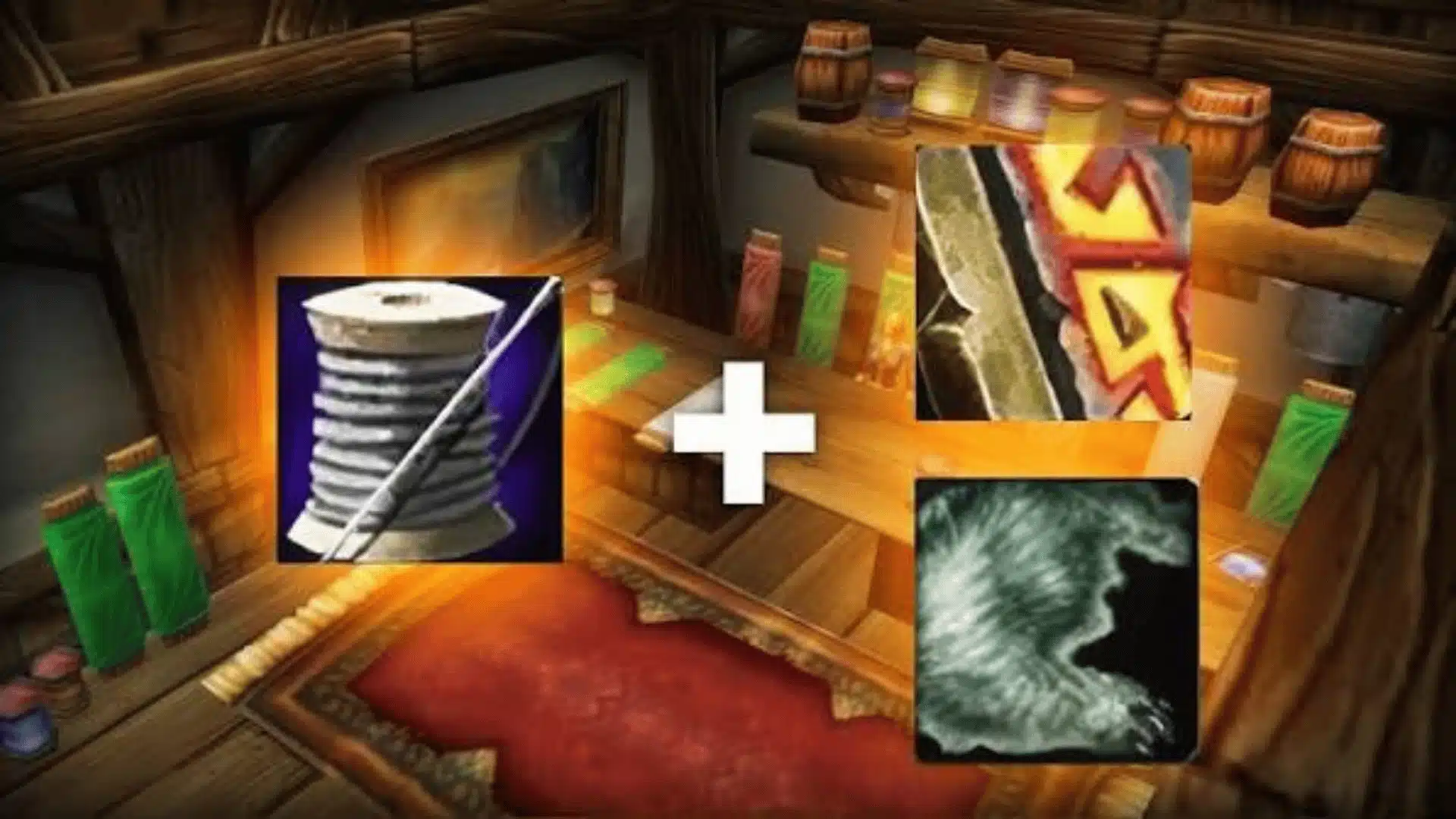
Tailoring doesn’t have a natural gathering companion like Mining for Blacksmithing or Herbalism for Alchemy. That frees your second profession slot, but it also means you need to choose carefully.
Tailoring pairs best with professions that make use of its byproducts or offer good synergy:
- Enchanting: The most practical and popular pairing. Cloth items you craft while leveling can be disenchanted into materials that directly feed your Enchanting progression, reducing Auction House dependency.
- Engineering: A strong alternative, especially for Mages and Warlocks who want gadgets and utility. It has no material overlap with Tailoring, so expect separate farming or gold investment.
- Herbalism or Skinning: Good for passive gold generation through raw materials, but they have no direct synergy with Tailoring.
- Recommendation: Enchanting remains the cleanest and most efficient choice for most players.
Herbalism or Skinningis sometimes chosen for passive income; theWoW Classic skinning guide covers leveling it efficiently. They generate raw gold but don’t interact with Tailoring.
If you want a second profession that complements what you’re already doing, Enchanting is the cleaner choice.
Conclusion
A tailoring guide classic works best when it helps you avoid waste before you start spending cloth, gold, or time.
Tailoring is strong because it fits into normal leveling, gives useful bags, and supports cloth classes without forcing a gathering profession.
You should plan your materials early, train before each skill cap, and keep extra cloth for the slower late levels.
I would also pair it with Enchanting if you want crafted gear to keep feeding another profession instead of becoming vendor trash.
Once your setup is ready, the 1 to 300 path becomes much easier to follow.
Which Tailoring recipe are you leveling toward first? Tell us, share with us in comments below.
Frequently Asked Questions
What Goes Best with Tailoring in WoW Classic?
Enchanting pairs best with Tailoring. Cloth items you craft while leveling can be disenchanted for Enchanting materials instead of being vendored.
That turns crafting byproducts into a direct resource for a second profession. No other pairing creates that kind of material loop with Tailoring.
Where Do I Learn Tailoring in WoW Classic?
Trainers for Apprentice and Journeyman are available in every major city for both factions. Expert Tailoring is taught in Stormwind and Ironforge for the Alliance, and Undercity for the Horde.
Artisan Tailoring, which unlocks the 225–300 bracket, requires Daryl Stack in Southshore for Alliance, or Josef Gregorian in Undercity for Horde. Train at skill 200.
Do I Need a Gathering Profession to Level Tailoring in WoW Classic?
No. Tailoring is the only crafting profession in WoW Classic that needs no companion gathering skill. Cloth drops from humanoid mobs as you level.
You can also buy it from the Auction House. Either way, your second profession slot stays free for something that complements Tailoring rather than just feeding it.
Where Do I Level Tailoring past 225 in WoW Classic?
You need Artisan Tailoring first. Train it at skill 200, Alliance from Daryl Stack in Southshore, Horde from Josef Gregorian in Undercity.
Once trained, the 225–300 stretch runs on Mageweave and Runecloth recipes are available from standard trainers. Don’t wait until you hit the wall to train it.