
Most players open a pokemon breeding guide, assuming it’s only for competitive veterans. It is not. It is simply the most reliable way to build any Pokémon you actually want.
Pokémon breeding looks complicated from the outside, but the core mechanics click fast once the sequence makes sense.
The real problem is not complexity; it is starting without knowing what matters.
Skipping one setup step early can quietly break a chain 10 generations in. That one detail is easy to miss until it costs you a full chain.
Here you will find everything laid out in the right order, from compatibility rules to IVs, natures, and shinies.
What is Pokémon Breeding and When Should You Use It?
Pokémon breeding is how you leave two compatible Pokémon at the Daycare and get an egg that hatches with inherited stats, moves, nature, and ability.
Wild-caught Pokémon are a complete gamble. Their IVs and natures are random, and there is no way to reliably control what you end up with.
I spent way too long trying to build a team from wild catches before breeding finally made everything click for me.
There are two main reasons to breed: building a competitive Pokémon with the right IVs and nature, or shiny hunting through the Masuda Method.
If you are still working through the main story, you do not need this yet. Breeding is a post-game and competitive tool, not a campaign necessity.
The biggest mistake I made early was starting without a plan. A clear target moveset and stat spread saves more time than any item, and a high-IV Ditto paired with your target species is always the right place to begin.
How Does the Breeding Mechanic Work (Daycare, Picnic, and Egg Hatching)?

Deposit two compatible Pokémon, wait for an egg, then hatch it by walking with a Flame Body Pokémon in your party. That is the entire loop.
The setup varies depending on your game, but the underlying logic remains consistent across all generations.
In generations 2 through 8, you leave your Pokémon at the Daycare and walk until an egg appears. In Scarlet and Violet, the Picnic mechanic replaces that, and eggs appear passively in a nearby basket.
Hatching still requires walking or riding with the egg in your active party. It does not progress while sitting in your bag.
Egg Group Compatibility Rules
Every breedable Pokémon belongs to at least one Egg Group. Only two Pokémon produce an egg if they are in the same group and are opposite genders.
Here’s what controls compatibility:
- Same Egg Group: Both Pokémon must share at least one group to produce an egg together.
- Opposite gender: One male, one female. Genderless Pokémon need Ditto as a partner. Nidoran (male) can fully breed but only with a female Nidoran.
- Ditto exception: Ditto bypasses the gender rule and breeds with almost any species.
- Undiscovered Group: Legendaries, Mythicals (except Phione), Ultra Beasts, Paradox, and baby Pokémon like Pichu, Cleffa cannot breed, even with Ditto.
Mewtwo is a common example of this. Despite being one of the most well-known Pokémon, it sits in the Undiscovered Group and cannot produce eggs at all.
I assumed Ditto worked with everything until I wasted time trying to breed a legendary. Checking the Egg Group first would have saved me the frustration.
Hatching Eggs Faster
Every egg has a fixed step count before it hatches, and that number varies by species. If yours feels slow, that is normal and not a bug.
The fastest way to speed this up is to keep a Flame Body or Magma Armor Pokémon in your active party while you walk:
- Flame Body: Cuts required hatch steps in half. Carried by Talonflame in older games.
- Magma Armor: Same effect as Flame Body, but with a different ability name.
- Fletchinder/Rolycoly: Easy Flame Body option in Scarlet and Violet, found fairly early in the game.
- Active party only: The ability does nothing if that Pokémon is sitting in your Box.
That last point tripped me up for longer than I would like to admit. The game does not warn you. Your Flame Body Pokémon must be in your lineup the entire time.
Once you understand the loop and compatibility rules, the mechanical side of breeding stops feeling complicated and starts feeling like a system you can actually control.
What You Need Before You Start Breeding (Items and Pokémon)?
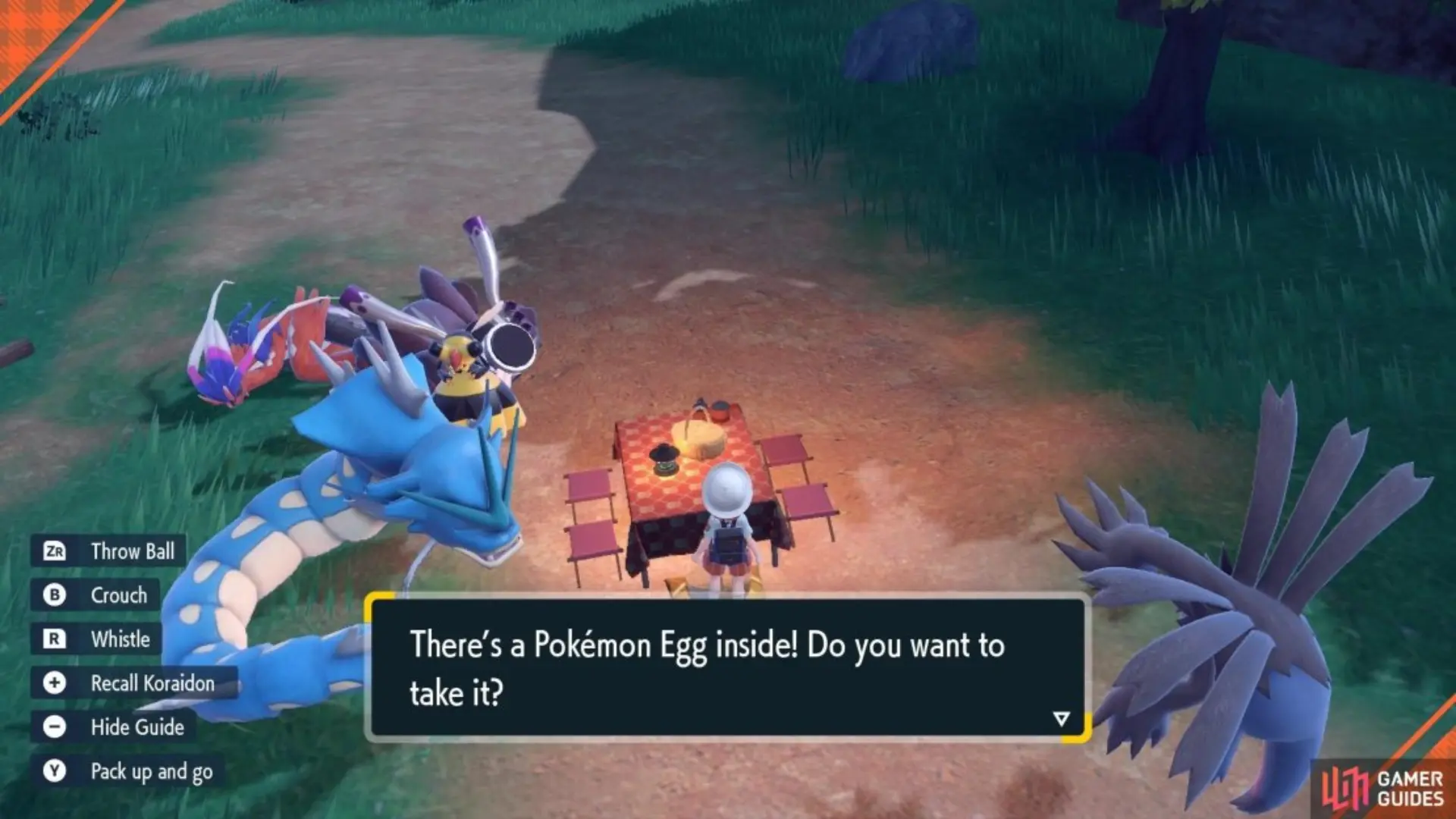
Before you touch the Daycare or set up a Picnic, four things need to be in place. Missing even one will slow your entire chain down in ways that are not obvious until it is too late.
Here’s what you actually need before starting:
- Destiny Knot: the core IV-passing item. Without it, stat inheritance is basically random.
- Everstone: locks a nature onto offspring. Essential before any serious chain begins.
- High-IV Ditto: the anchor of every breeding setup.
- IV Judge: the function that lets you read your Pokémon’s stats and evaluate progress.
I did not have all of these my first time. I just started breeding and wondered why nothing was improving.
Why Should You Get a High-IV Ditto?
Ditto is the most important Pokémon in any breeding chain. It breeds with almost any species, skips gender requirements, and its IV spread directly seeds every generation you build.
What I got wrong early was assuming any Ditto would do.
I grabbed one from the wild, slapped a Destiny Knot on it, and started hatching eggs, wondering why my results were so inconsistent.
A low-IV Ditto quietly caps your entire chain from egg one. You will not notice it immediately, but you will feel it after a dozen generations of marginal improvement.
Here’s where to find a good one:
- Raid dens in Scarlet and Violet: High-IV Dittos appear in specific dens and are worth farming early.
- Area Zero: Ditto spawns here naturally and can have strong IVs depending on the encounter.
- Trading communities: Smogon and VGC forums regularly have players offering 6IV Ditto at no cost.
Trading was the route I took eventually. It saved me hours I would have spent grinding for something I could just ask for.
Unlocking the IV Judge
The IV Judge shows each stat’s rating directly on your Pokémon’s summary screen. Without it, evaluating parents and offspring is just guesswork.
In Scarlet and Violet, it unlocks by finishing the main story, completing all three questlines, and becoming Champion.
Once the credits roll, head to any Pokémon Center, and the nurse will let you know the Judge function is live. In older games like Sword and Shield, a Battle Tower rank milestone triggered it.
Same idea, different gate.
Once I had it unlocked, everything moved faster. Knowing which eggs to keep and which to release turns a slow grind into something that actually feels like progress.
Keep your Flame Body Pokémon in your active party throughout all of this. That part has not changed, and it is still easy to forget when you are deep in item setup.
Getting these four things in place before your first egg doesn’t overcomplicate it. It is just the difference between a clean chain and hours of quiet backtracking you did not see coming.
How to Breed for Perfect IVs (Destiny Knot and the Multi-Generation Method)?

The Destiny Knot causes the holding parent to pass exactly five IVs, randomly drawn from the combined twelve-IV pool of both parents. The sixth IV is always randomized fresh.
Passing five IVs may sound simple, but what happens beneath the surface matters more than the number itself. The game is not picking the five best. It picks five at random for every single egg.
The 6th IVs in the offspring are always generated fresh, completely at random, regardless of how strong both parents actually are.
That means a parent with a perfect Attack IV does not guarantee a perfect Attack offspring. It raises the probability across multiple eggs, but nothing is ever locked in.
Breeding up gradually, improving one or two IVs per generation by swapping better offspring in as parents, is faster and more reliable than chasing a perfect hatch.
The most costly mistake I made was locking in my nature parent too early before its IVs were solid. That decision point matters more than any single item or mechanic in the chain.
If you want to test those breeding skills in a harder fan game, Pokemon Unbound gives you more demanding battles and team building choices.
The Multi-Generation Breeding Chain
The chain is straightforward once you see it as a progression rather than a single attempt. Here is how to run it step by step:
- Start with parents: Use your high IV Ditto and the target species as the breeding pair.
- Give Destiny Knot: Give it to the parent with the better IV spread.
- Hatch eggs: Hatch a batch and check each one with the IV Judge.
- Promote offspring: Replace the weaker parent with the best offspring and repeat.
- Stop point: Stop once you get five perfect IVs in the stats your build needs.
In VGC and competitive play, five IVs are the practical target. The sixth stat, often Speed on a Trick Room Pokémon or HP on a support, is sometimes intentionally left imperfect.
Replacing the weaker parent with a better offspring each generation is what moves the breeding chain forward.
I held on to my original breeding pair for too long in my early attempts, which slowed my progress more than necessary.
Breeding for a 0 IV (Trick Room and Support Pokémon)
Some competitive sets actually need a 0 Speed IV rather than a perfect one. Trick Room teams want their Pokémon moving last, so minimum Speed is the goal.
The way to breed for this deliberately is to use a parent that already has a 0 Speed IV and let the Destiny Knot carry it forward across generations. This uses the same logic as breeding up for a 31.
Once I started playing Trick Room formats in VGC, this became just as routine as standard IV breeding. It takes a mindset shift to see 0 as a target rather than a failure.
How to Pass Down Nature and Ability?
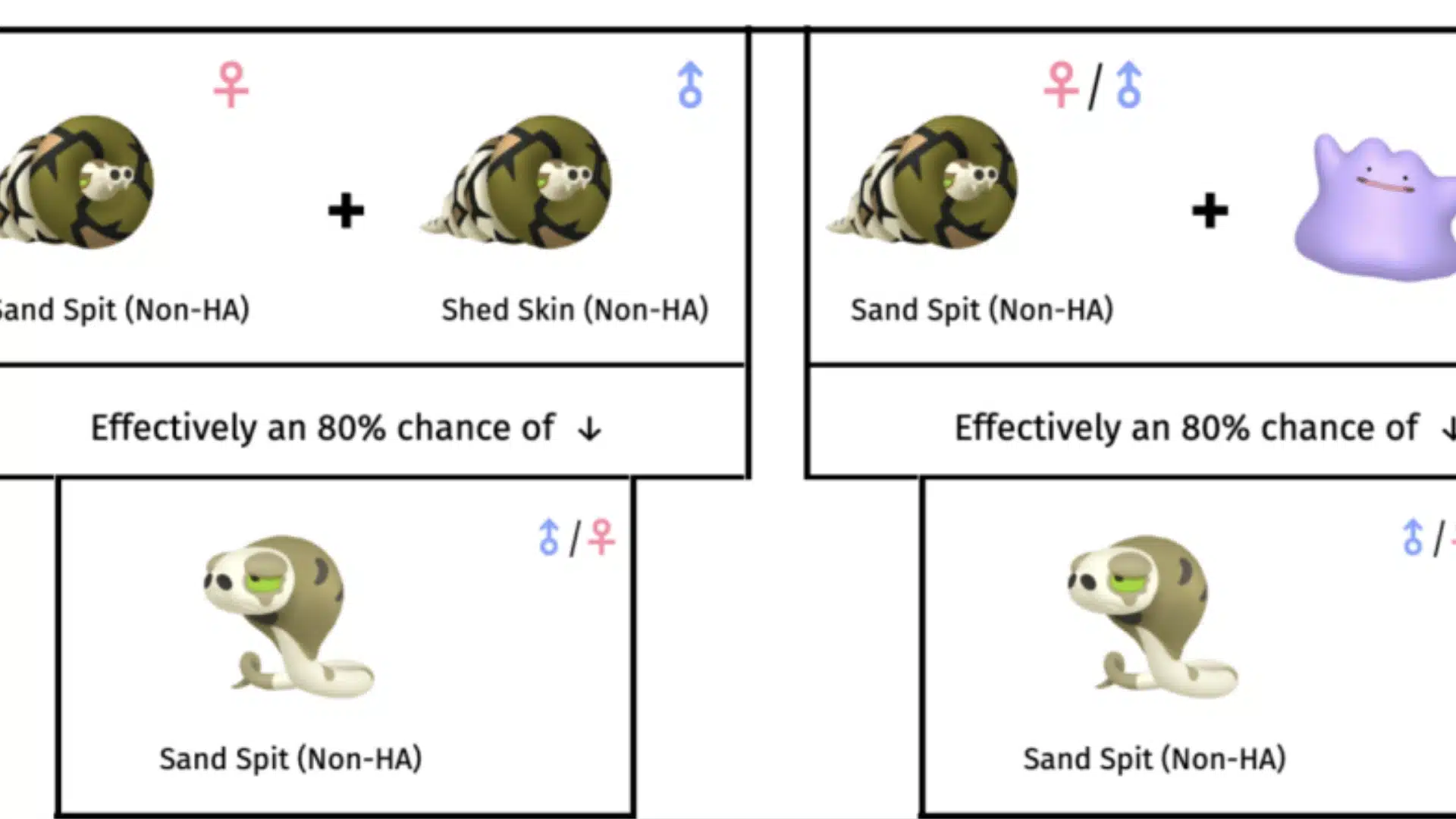
Nature and ability are two separate decisions, but they share one failure point. Getting the sequence wrong early can quietly break a chain you have already invested hours into.
The fix is simple. Sequence them deliberately instead of trying to handle both at once.
Locking the Right Nature with Everstone
Give the Everstone to whichever parent has the nature you want. That parent passes its nature to 100% of offspring, every single egg, with no exceptions.
Unlike the Destiny Knot, this is completely deterministic. There is no randomness involved, which makes it the one part of breeding you can fully control from the start.
Here’s where the cascade failure happens, and I have seen it trip up a lot of players including myself.
The mistake is giving the Everstone to your high-IV parent before checking whether it actually has the right nature.
Once that Everstone is locked in, every generation inherits that nature. If it is wrong, you cannot patch it. You must restart from a new nature parent entirely.
The fix is to confirm the nature first, then begin building IVs on that parent. Sequence matters here more than anything else in the early chain setup.
Before moving on, ask yourself: does your Everstone parent have the right nature? Does it or the other parent have the ability slot you need?
Breeding for Hidden Abilities
Hidden Abilities do not appear randomly in offspring. You need at least one parent who already has the Hidden Ability before it can be passed down through the chain.
In most games, the female parent carries it forward. In Scarlet and Violet, either parent can pass it down, making the process a bit more flexible than in older generations.
Here’s how ability inheritance works across the board:
- Standard abilities: Pass down from the mother at roughly an 80/20 split, favoring whichever slot she’s carrying
- Hidden Ability: Requires one parent to already have it. It cannot appear from nothing
- Ability Capsule: Switches a Pokémon between its two standard ability slots. It does not unlock Hidden Ability
- Ability Patch: Unlocks the Hidden Ability on a standard Pokémon. Expensive and postgame-locked in Scarlet and Violet
I made the mistake of assuming I could breed a Hidden Ability into a chain without already owning one. You cannot.
If your target needs a Hidden Ability, acquiring one before starting the chain is the move. Trying to work around it mid-chain costs more time than just getting it right at the start.
How to Pass Down Egg Moves?
Egg Moves are moves a Pokémon can only learn through breeding. They are not available through level-up, TMs, or the move reminder in that species.
I learned this the hard way after finishing a full IV chain and realizing the move I wanted was never going to appear without starting over.
Planning your moveset before the first egg is not optional. It is the one thing that saves you from having to rebuild a chain you already spent hours on.
Checking and Planning Egg Moves Before You Breed
Before anything else, check which moves for your target Pokémon are Egg Moves only. Bulbapedia is the fastest way to do this because the in-game move reminder does not show what you are missing.
Here’s what to confirm before your chain starts:
- Which moves are Egg Move exclusive? These can only appear at hatch, not taught later in most games.
- Which parent knows the move: The move-source parent must have it in its active moveset at the time of breeding.
- Whether Scarlet and Violet’s Picnic transfer applies: Two Pokémon of the same species can pass Egg Moves to each other during a Picnic, no chain parent needed.
- Whether the move comes from a different Egg Group: If it does, you will need a chain breeding step before your main chain begins
In Scarlet and Violet, the same-species Picnic transfer removes a lot of the complexity. In older games, missing an Egg Move means rebreeding, with no shortcuts available.
Chain Breeding for Multi-Group Egg Moves
Chain breeding is used when the Pokémon that knows your target Egg Move does not share an Egg Group with your final species.
You breed through an intermediate Pokémon that connects the two. Here’s a simple example of how a chain works:
- Step 1: Identify the move-source Pokémon and which Egg Group it belongs to.
- Step 2: Find an intermediate Pokémon that shares a group with both the source and your target.
- Step 3: Breed the move onto the intermediate first, then breed that into your main chain.
- Step 4: Confirm the move appears on the offspring before continuing the IV chain.
It sounds more complicated than it is once you’ve done it once. The intermediate step usually only takes a handful of eggs before you have what you need.
In Scarlet and Violet, the Picnic transfer mechanic reduces the frequency with which chain breeding is necessary.
If one of your Pokémon already knows the move, a same-species Picnic session can pass it across without any intermediate steps.
Always verify the move is present on your final chain parent before hatching eggs at scale. Discovering that it is missing 20 eggs is a frustrating and entirely avoidable setback.
Breeding for Shinies: The Masuda Method
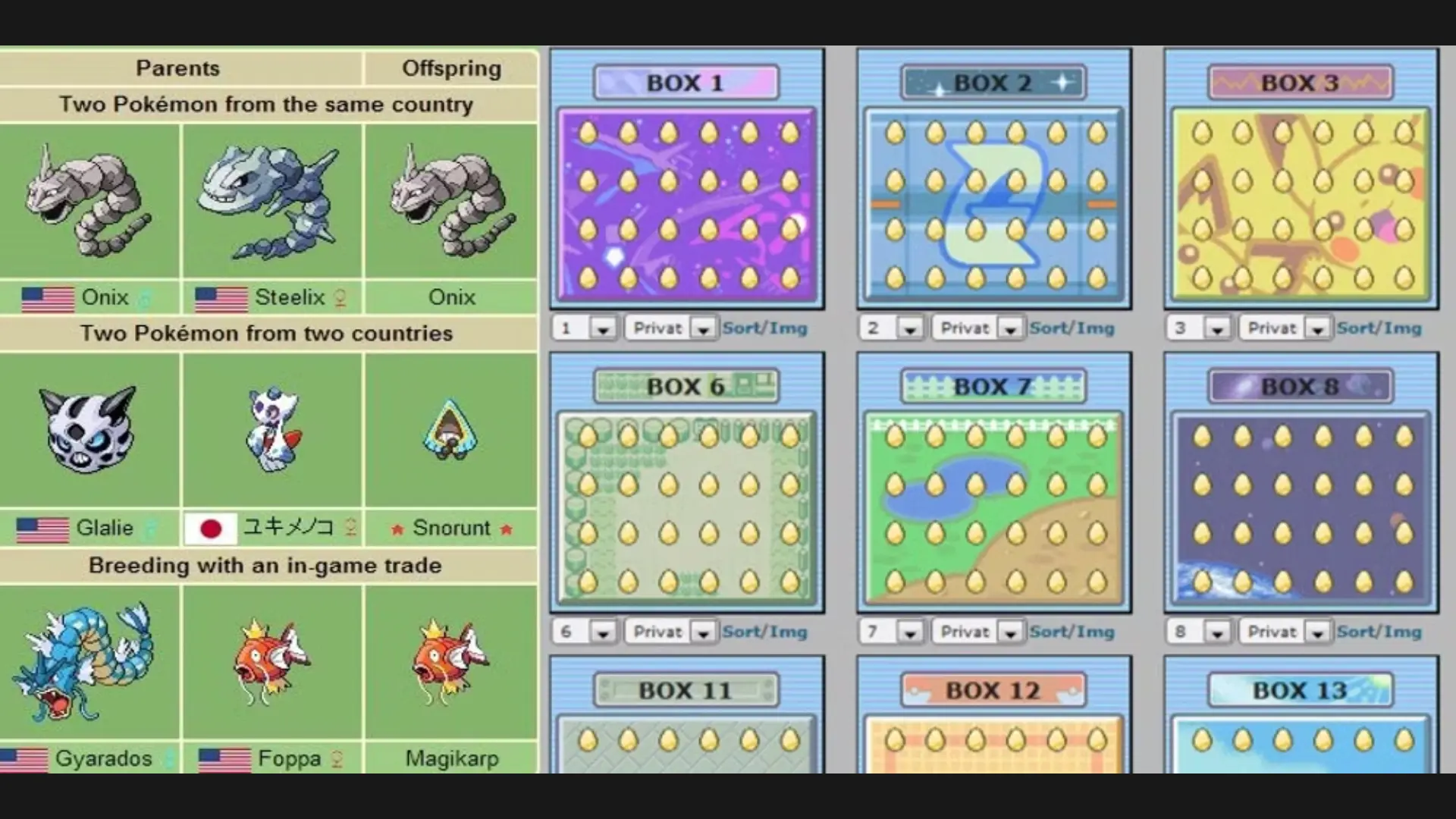
Shiny hunting through breeding requires a different mindset from competitive breeding. The setup is actually simpler, but the time investment is something I was not fully prepared for the first time.
If your only goal is a shiny, you do not need a perfect IV chain running. You just need the right pair, the right items, and realistic expectations going in.
One thing I wish someone had told me earlier is that some Pokémon are shiny-locked. Certain legendaries cannot be obtained shiny through any method, including breeding.
Check before you commit hundreds of eggs to something that was never possible.
How does the Masuda Method Work?
The Masuda Method works by breeding two Pokémon from games set to different languages. This raises the odds of a shiny from roughly 1 in 4096 to roughly 1 in 683, or 1 in 512 with a Shiny Charm.
What I got wrong initially was thinking this required two players from different countries. It does not. The language setting of the game is what matters, not where anyone is from.
I traded for a foreign-language Ditto through Smogon and had the method running the same day.
Communities like that regularly have players offering foreign Ditto for free, and it is one of the easiest trades to find anywhere online.
Speeding Up Egg Production in Scarlet and Violet
In Scarlet and Violet, Egg Power sandwiches increase the speed at which eggs appear during a Picnic session. Once I started using them, the difference in egg volume per sitting was immediately noticeable.
The effect stacks with the Masuda Method and the Shiny Charm, so running all three together is the most efficient setup I have found for shiny breeding in Scarlet and Violet.
Sandwich ingredients that trigger Egg Power are available in-game, but availability has shifted across patches.
I would check current community resources before committing to any specific recipe rather than relying on older guides.
Common Breeding Mistakes and How to Fix Them
Most breeding frustrations aren’t bad luck. They’re setup errors that look like RNG variance until you know what to check.
I’ve made most of these myself at some point. Running through this list before assuming your chain is just unlucky will save you a lot of time.
Here are the 6 most common mistakes and exactly how to fix them:
| Mistake | What You See | The Fix |
|---|---|---|
| Everstone on the wrong parent | Offspring keep inheriting the wrong nature | Move the Everstone to the parent with the nature you actually want |
| Destiny Knot on the weaker parent | IV spread improves slowly across generations | Give the Destiny Knot to whichever parent has the better IV spread |
| Flame Body Pokémon in the Box | Eggs take much longer to hatch than expected | Move your Flame Body Pokémon into your active party, not just your collection |
| Missing Egg Moves before starting | Target move never appears on offspring | Check Bulbapedia for Egg Moves before your first egg, not after |
| Breeding an Undiscovered Group Pokémon | No egg ever appears despite leaving Pokémon at Daycare | Check the Egg Group, legendaries and baby Pokémon cannot breed at all |
| IV Judge not unlocked | No way to evaluate parents or offspring accurately | Complete the required postgame content to unlock the Judge function first |
The pattern I noticed across all of these is that the symptom always appears to be a random outcome. Eggs taking forever feels like bad hatch luck. Weak IV spreads feel like the Destiny Knot not working.
Most of the time it’s a one-step fix sitting right in your setup. Check the table first before assuming the game is just against you.
Conclusion
A pokemon breeding guide works best when it helps you follow the right order instead of hoping every egg works out.
You should set up Ditto, Destiny Knot, Everstone, IV Judge, and Flame Body before starting a serious chain.
I would always lock the nature first, check abilities early, and confirm Egg Moves before hatching too many eggs.
Perfect IVs, Hidden Abilities, and Masuda Method shinies become much easier once your setup stops changing halfway through.
Your first chain may feel slow, but each clean step saves time you would otherwise lose fixing mistakes later.
Which Pokémon are you breeding first, and are you aiming for perfect IVs or a shiny? Tell us, share with us in the comments below.
Frequently Asked Questions
Can I Breed Pokémon with Different Egg Groups?
No, they must share at least one Egg Group. The only exception is Ditto, which can breed with almost any Pokémon outside the Undiscovered Group.
Does the Gender of the Ditto Matter when Breeding?
No. Ditto is genderless and can breed with both male and female Pokémon, making it the most flexible partner.
What Happens if Both Parents Hold Items Like Destiny Knot and Everstone?
Both items work simultaneously. The parent holding the Everstone passes the nature, while the parent holding the Destiny Knot passes five IVs.
How Do I Get a 6IV Pokémon?
Breed until you have a strong 5IV parent, then use Hyper Training on the final offspring or continue breeding until the sixth stat lands perfectly by chance.
Do Egg Moves Carry over if I Evolve the Pokémon Later?
Yes. Once a Pokémon learns an Egg Move, it keeps the move through evolution in most cases.
Can I Use a Shiny Parent to Breed a Shiny Offspring?
No. Shininess is not inherited through breeding. You still need the Masuda Method or Shiny Charm to improve your odds.