Most launch reviews scored a build that no longer exists. Many players judged the game too soon, missing improvements and content added in updates over the years.
This Assassin’s Creed Valhalla review evaluates the game as it exists today.
Early complaints about combat weren’t entirely wrong; they often hadn’t found enough Books of Knowledge to upgrade skills.
That lack of clarity is a real design quirk, one that took time for many players to grasp.
Today’s version is more stable, more understandable, and delivers a clearer sense of how the game plays and evolves.
Here, you’ll find an honest assessment of what works and what doesn’t. This review explains the experience, challenges, and the type of player this game genuinely caters to now.
What Kind of Game is Assassin’s Creed Valhalla?
That’s a bigger shift than it sounds. Origins and Odyssey gave you abilities as you leveled up. Valhalla makes you go find them.
I went in expecting something close to Odyssey. The first few hours felt stripped back: fewer abilities, less feedback, more patience required.
What I didn’t realize was that I hadn’t found my build yet. Not because I was under-leveled, but because I hadn’t explored enough.
A few things worth knowing before you start:
- Not a stealth-first game: The hidden blade is back, but Valhalla is built around a Viking warrior fantasy, not sneaking through every encounter.
- Not Odyssey with Vikings: Same engine, very different pacing. Valhalla is slower to open up and more deliberate about what it gives you.
- Exploration isn’t optional: It’s how you unlock the abilities that make combat feel good. Treating it as optional breaks the whole system.
Once that clicked for me, the game made a lot more sense. Whether it works for you depends on the kind of AC player you are, and that’s worth figuring out early.
If you came to Valhalla straight from a game with a tighter, more focused open world, as our Ghost of Tsushima review covers, the pacing difference will hit you fast.
How Combat and Progression Actually Work and Why the First Hours Feel Flat?
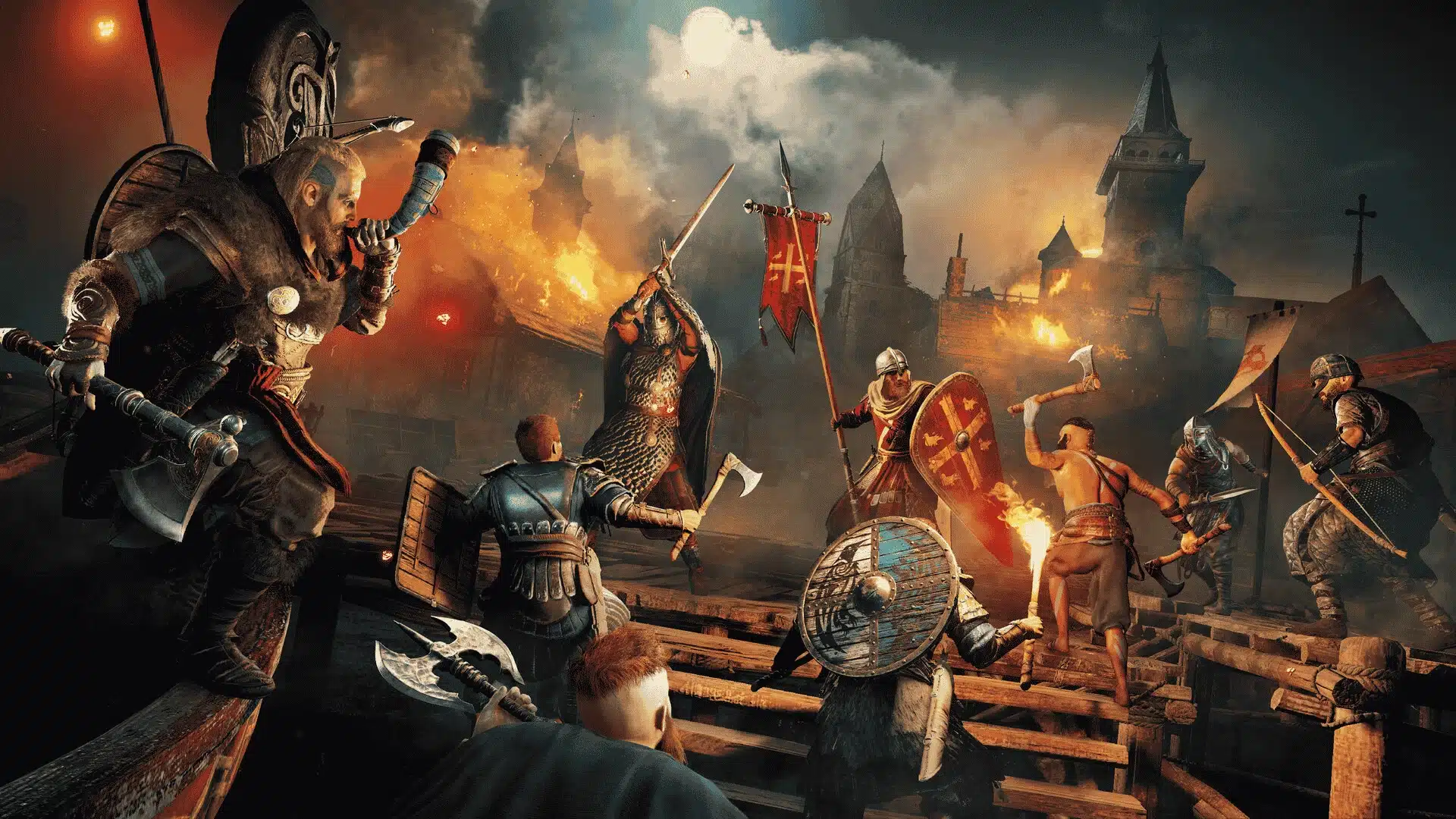
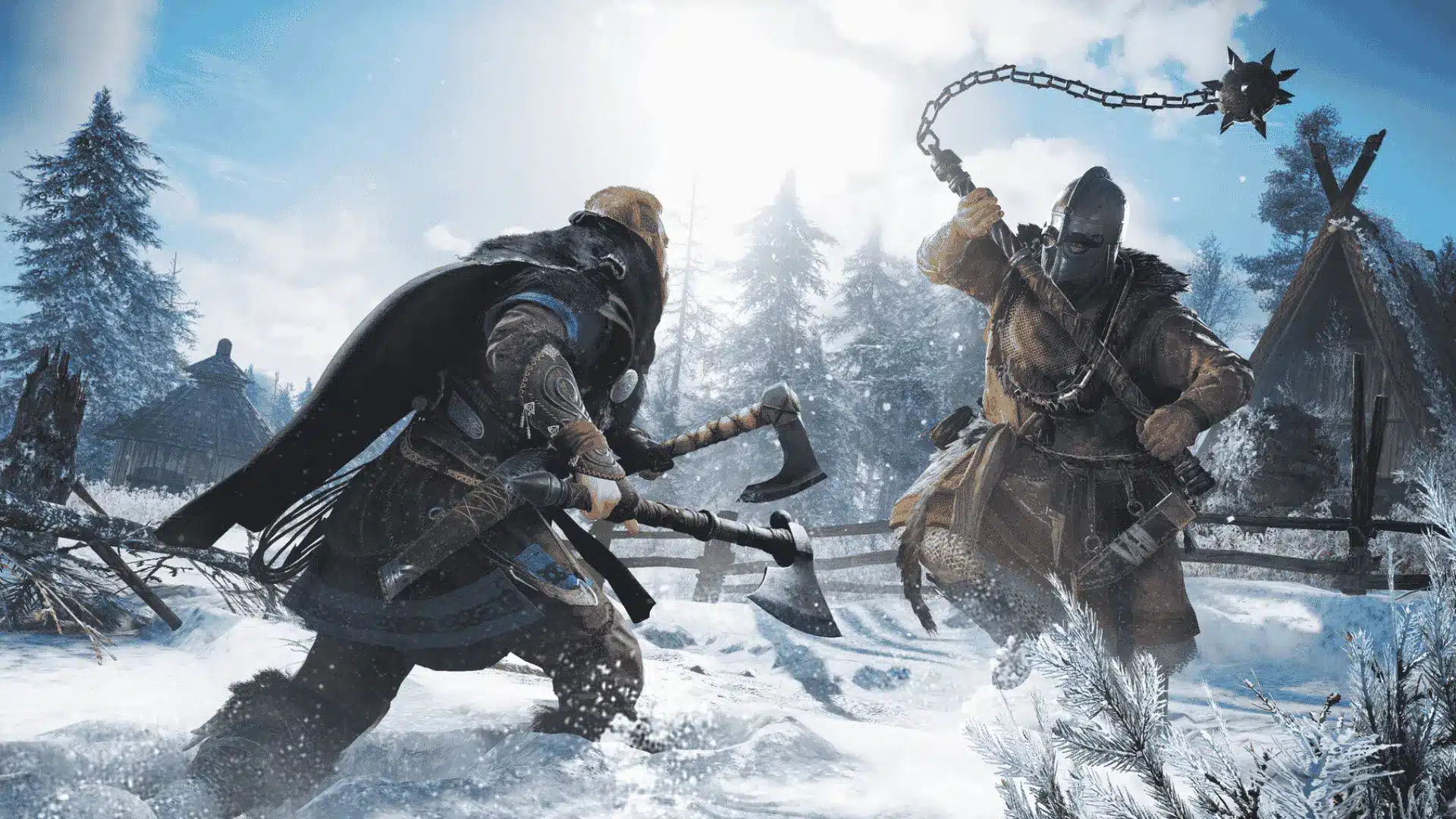
Valhalla’s combat is genuinely strong, but it only reveals itself after 15 to 20 hours of exploration. That slow build-up changes how the whole system should be judged.
Combat abilities aren’t unlocked through leveling. They’re Books of Knowledge: physical discoveries hidden across monasteries, vaults, and camps that directly expand your fighting toolkit.
Early story-chasers hit hour 10 still pressing two buttons, feeling cheated. Proper exploration can net 4 abilities in one afternoon, transforming the system completely.
This is deliberate design, not a flaw. Valhalla gates combat depth behind exploration as a philosophical reward; whether that trade-off works depends on what you want from an RPG.
Once you’ve found enough Books of Knowledge, combat splits into two stances you’ll actually feel: Bear stance for slow, heavy damage, and Eagle stance for speed and mobility.
Switching between them mid-fight, rather than picking one and sticking with it, is where the combat starts to click.
1. The Skill Constellation and What It Actually Does
The skill constellation web has over 400 nodes across three paths. Most are small stat boosts, useful but not exciting.
The meaningful unlocks sit at the center of each cluster. Skills likedual-wielding heavy weapons or stomping a downed enemy actually change how you fight.
Here’s what makes it awkward early on:
- Fog-hidden clusters: Neighboring skill groups stay hidden until you spend points to reach them; you can’t see what you’re working toward.
- Passive vs. active nodes: Most nodes are minor stat bumps. The impactful skills are buried deeper in each cluster.
- Free resets: You can reset the entire tree at any time, for free, which takes the sting out of early mistakes.
There’s a trade-off worth knowing. Exploring heavily levels you faster than the regions around you.
The loop: explore to find abilities → over-explore early regions → outpace the power curve → difficulty drops off mid-game. The workaround, manually removing skill points, works, but it’s clunky.
2. Weapons, Gear, and Why There’s Almost No Junk Loot?
Valhalla doesn’t drop random loot. Every weapon is a specific item with its own look and passive bonus.
Finding something new actually means something here. Key points about the system:
- Upgradeable gear: Every weapon scales with materials; a good early find can carry you to the end.
- Dual-wield options: Mix any two weapons, including the heaviest ones, with the right skill unlocked.
- Rune augmentation: Slot runes into gear for stacking passive bonuses that support your build.
One personal note: don’t skip the spear. Its two-handed heavy attack lets you impale and throw enemies, one of the most satisfying moves in the game.
3. Stealth and Assassination: Two Modes, One Hidden Blade
The hidden blade returns, and one-hit assassinations are possible again. How it works depends on the target:
- Advanced Assassination: Tougher enemies trigger a quick-time event, land it, and they die; miss it, and the fight starts.
- Guaranteed Assassination: A settings option that removes the QTE and kills any enemy instantly. The game flags it as off-script, but it’s there.
- Independent stealth slider: Stealth difficulty is separate from combat tuning, and adjusting each one independently is what made both systems click for me.
The main issue is enemy detection. Guards spot you quickly on default settings, and stealth breaks faster than it should.
Zealots, roaming high-level enemies tied to the Order of the Ancients, are worth flagging here. They’re a genuine difficulty spike and don’t play by normal stealth rules.
When both systems are tuned right, they complement each other well. The payoff is real; it just takes patience and some manual setup to get there.
Players coming from a more forgiving stealth loop, closer to what our Wolfenstein: Youngblood review describes, will want to adjust these sliders before their first real fight.
The World, the Settlement, and Whether the Open World Holds Up
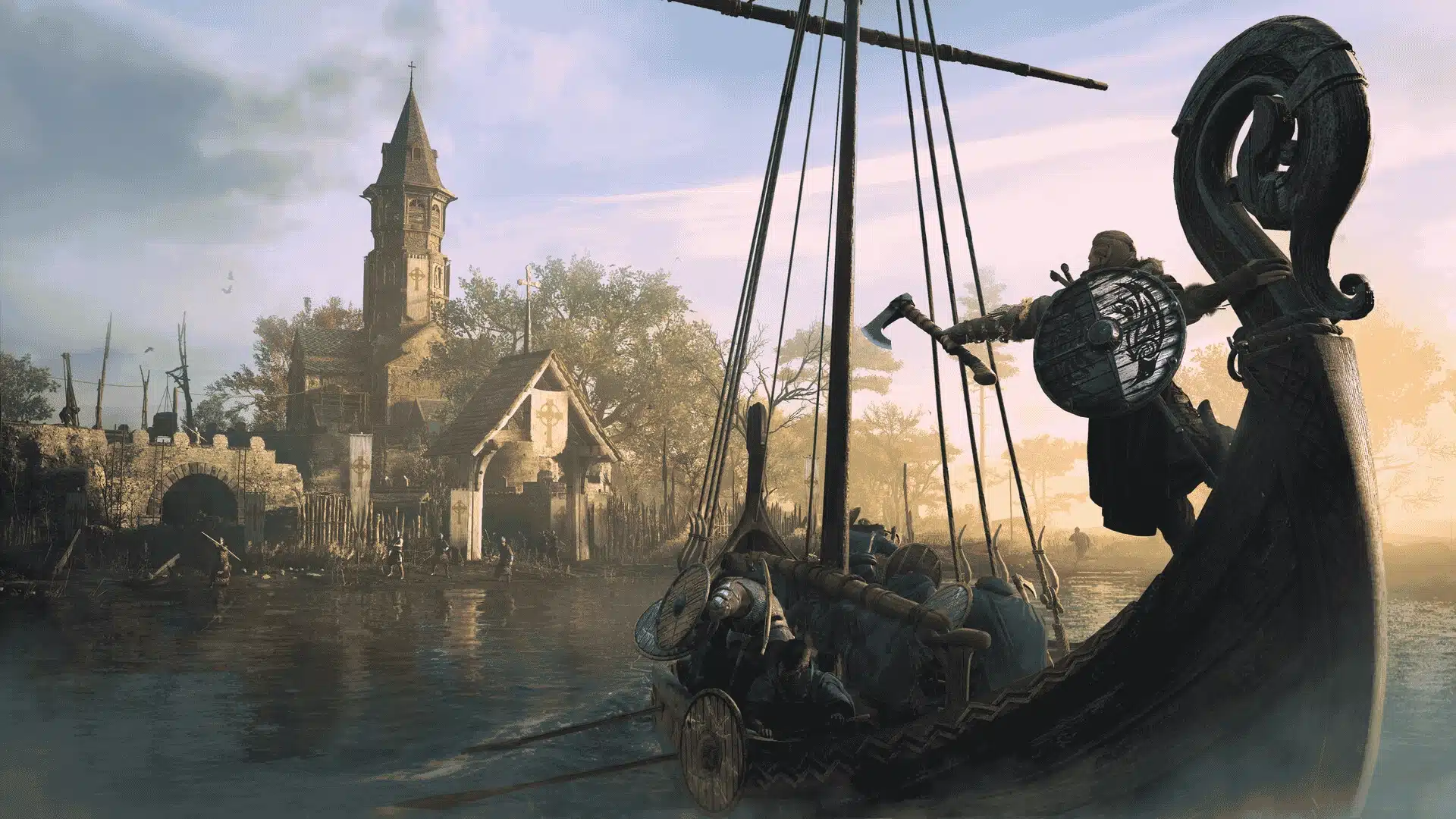
Valhalla’s open world is large, visually exceptional, and more structured than Odyssey’s, but it starts to repeat itself around the halfway point.
The size isn’t the real problem. The regional arc formula is.
Each region follows the same basic shape: arrive, build a political alliance, solve a problem, move on. That structure works well early and becomes predictable by hour 40 or 50.
The Settlement: What It Does and Where It Stops Mattering?
Ravensthorpe grows throughout the game using materials from raids. Early upgrades feel meaningful and change how you play.
The buildings that actually matter:
- Blacksmith: Upgrades weapons and armor. Build this one first.
- Bureau: Advances the Assassin storyline, so plot missions stay locked without it.
- Barracks: Recruit and customize your Jomsviking raid crew here.
- Stable: Unlocks mounts and riding upgrades, which matter more than the longship ever does.
After those core upgrades, returns drop off fast. Later buildings give minor stat bonuses with almost no gameplay impact.
The Jomsviking and longship systems are the clearest examples of underused potential. Your custom Viking companion only shows up during water raids, which happen far less than expected.
Most of England connects by river, but riding a horse is almost always faster. I used the longship almost exclusively for monastery raids, nothing more.
England and Norway: What the Map Does Well and Doesn’t
The Norway prologue is short, two to three hours, but it sets up the tone and story well before England opens up.
England spans four kingdoms: Mercia, East Anglia, Northumbria, and Wessex, each with its own political story. Here’s how the map holds up across the board:
- Visual fidelity: Rolling hills, river valleys, and fog over marshland are genuinely beautiful on current-gen hardware.
- Historical accuracy: Saxon England locations sit roughly where they should, with real cultural texture throughout.
- NPC density: Towns feel underpopulated. Most NPCs are copy-pasted with no meaningful interaction.
- Location variety: After enough hours, monastery layouts and outpost designs start blending together across regions.
The world looks lived-in but doesn’t quite feel that way up close.
The same power-curve issue covered earlier shows up hardest here: by mid-game, regions that should feel challenging often don’t, since England’s difficulty is tuned around a pace of exploration most players will have already blown past.
If the formula fatigue hits, skipping lower-priority regions and pushing the main story forward is a completely valid approach.
Fans of Norse-flavored combat who want a tighter, less sprawling alternative might also want to see how our God of War Ragnarok review stacks up against Valhalla’s version of the mythology.
Mysteries, Wealth, and Artifacts: The Side Content System
Valhalla replaces traditional side quest lists with three map categories. Mysteries are the most interesting, unmarked blue dots you won’t understand until you arrive.
Here’s what you might find:
- Side quests: Short, self-contained stories, strange, funny, or occasionally dark.
- Cairns: Stack rocks using physics, simple but satisfying.
- Standing Stones: Find the right angle to align a hidden symbol across scattered stones.
- Flyting: Rhyming verbal duels closer to Monkey Island insult fights than actual rap battles.
- Legendary Animals: High-level hunts that scale with your build.
The format works better than Odyssey’s quest lists because nothing feels like a checkbox; you stumble into things rather than tracking them down.
Orlog, a dice board game found throughout the world, also lives here.
Two players trade dice rolls and god-favor cards to whittle down each other’s health, and the runs are short enough to play between quests. It’s one of the most praised parts of Valhalla, and that reputation is earned.
The variety holds up for the first half of the game. By hour 60 or 70, structural thinness and repeated location types start to show, but the content itself stays well-made throughout.
If side content fatigue is a concern going in, our Remnant: From the Ashes review is a useful comparison point for how a smaller open structure avoids some of that repetition.
The Story of Eivor, Sigurd, and What Valhalla Is Actually Trying to Say?
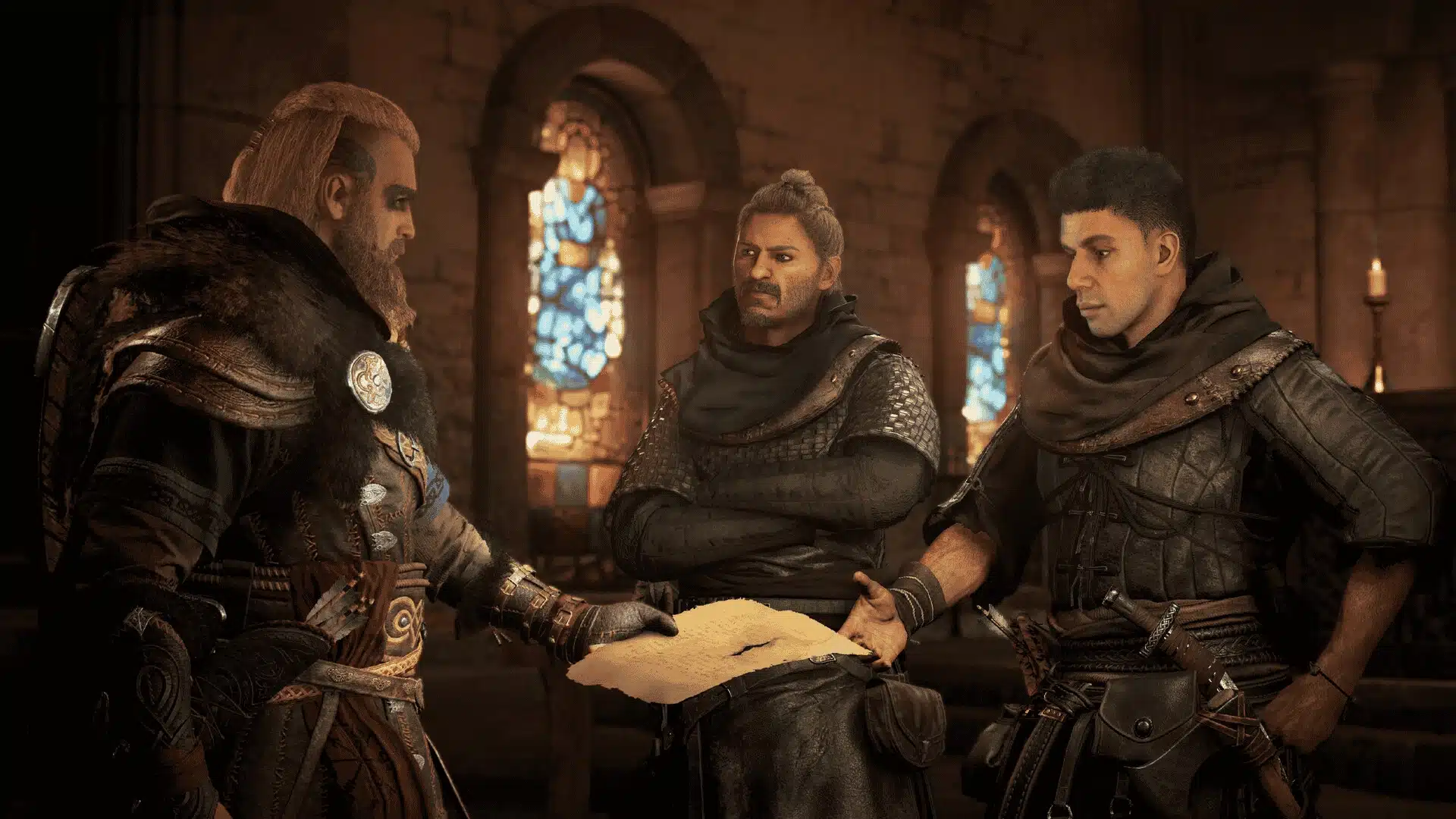
Valhalla tells a grounded, character-driven Viking saga, strongest as a political drama, uneven across its 11-region structure.
It’s not a tight conspiracy thriller. Players expecting one will find it frustrating.
The story runs on three tracks: Eivor’s personal arc, political alliance-building across England’s four kingdoms, and the Assassin/Order of the Ancients undercurrent. The first two are the real story. The third is texture.
Understanding that hierarchy changes how the whole game reads.
1. Eivor and the Small Stories
What makes Eivor stand out from previous AC protagonists is what they choose to protect, more than what they destroy.
The game shows this mostly through small moments rather than cutscenes. A few examples:
- The last leaf: A child asks Eivor not to let it fall before her father returns, quietly devastating.
- The axe in the skull: A stranger needs help with an obvious problem he refuses to acknowledge. Strange, funny, and oddly moving.
- The mock raid: Children idolizing the wrong kind of warrior and Eivor quietly reckoning with what that means.
These moments take under 5 minutes each. They do more for character than most main quest dialogue.
Eivor’s settlement companions follow the same pattern: rough Vikings given at least one spotlight moment to become something more than background.
2. The Alliance Arc and Regional Story Formula
Each region follows a familiar shape: arrive, build a political alliance, solve a crisis, move on. Think of serialized TV as more than a single linear plot.
The format has real strengths and a clear ceiling:
- Murder mystery arc: One region runs a slow-burn whodunit that stands as some of the best writing in the game.
- Political betrayal: Several arcs end with no clean resolution, morally messy in a way that feels deliberate.
- Religious transition: The encroachment of Christianity over the old Norse ways runs quietly through everything, paying off near the end.
Sigurd serves as a structural counterweight to Eivor, built to create friction and discomfort, so disliking him is a sign the arc is doing its job.
Alfred the Great appears throughout as a historical presence, not a villain, but a force quietly reshaping the world Eivor is trying to hold onto.
3. Mythology, Asgard, and the Isu Thread
Valhalla leans into Norse mythology more directly than any previous entry. The Asgard sequences let you play as Odin in a mythological realm tonally separate from the main story.
Here’s how the mythology layer breaks down:
- Asgard sequences: Accessed through a vision brew, visually distinct, slower-paced, divisive among players.
- Isu framing: The Norse gods are presented as an advanced pre-human civilization. It’s the same thread from Origins and Odyssey, handled with more ambition here.
- Modern-day storyline: Features Layla Hassan, Rebecca, and Shaun. Rewarding for series veterans, safely ignorable for everyone else.
The mythology content doesn’t demand prior series knowledge, but it rewards it.
What makes Valhalla’s story divisive is also what makes it interesting: it trusts the player to find meaning in small moments rather than handing it over in cutscenes.
Bugs, Performance, and the Launch-Era vs. Current-State Distinction
Valhalla launched with a significant number of bugs across all platforms; many have since been patched, but launch-era reviews reflect a different game than what you’ll play today.
If you’re using early scores to decide whether to buy, that context matters. At launch, the problems were hard to ignore. The most common issues included:
- Quest-breaking NPCs: Key characters getting stuck in rivers or simply refusing to move, halting mission progress entirely.
- Hard crashes: Multiple reviewers reported being kicked back to the dashboard mid-session on both Xbox and PlayStation.
- Enemy AI failures: Zealots regenerating health mid-fight, enemies running in tight circles, guards ignoring arrows mid-combat.
- Animation glitches: Boss characters T-posing before cutscenes, facial animations misfiring during key story moments.
Most launch issues have been patched out. The version you install today is meaningfully more stable than what shipped in 2020; minor quest bugs still surface occasionally, but rarely.
Facial animations remain the most consistent current complaint. Conversations look robotic, and that won’t change at the engine level, except to the extent patches can fully resolve it.
Performance on PS5 and Series X is clean: near-60 fps at 4K, short load times, and smooth world streaming. Last-gen hardware told a different story at launch, with choppy cutscenes and framerate drops.
That last-gen gap matters less now. On current-gen hardware, Valhalla is fully playable and mostly stable; rough edges remain, but nothing qualifies as a dealbreaker.
Is Assassin’s Creed Valhalla Worth Playing Now?
Yes, especially at its current sale price if you enjoy exploration-driven open worlds. Less so if you want tight stealth or a quick time commitment.
The answer depends entirely on what you want from it.
Valhalla was a commercial success and holds a Metascore of 80 on Metacritic, reflecting generally favorable reviews from critics, against a user score of 6.1 from over 4,000 player ratings that shows the opinion split closer to the middle.
That gap exists because the game asks a lot of players before it reveals its full depth.
Before deciding, consider the real trade-offs:
- Time: Main story runs 50–60 hours. Full completion reaches 90–150 hours.
- Learning curve: Combat and progression don’t open up until hours 15–20.
- Repetition: The regional arc formula becomes predictable in the back half.
None of these are dealbreakers on their own, but stacked together, they matter.
If you like open-world exploration and can push past the slow start, Valhalla earns its time. If you can’t, it won’t get better.
If you’d rather try a Viking-flavored world with a lighter time commitment first, our Skyrim modding guide is worth a look for a different kind of open-world fix.
If you like open-world exploration and can push past the slow start, Valhalla earns its time. If you can’t, it won’t get better.
Conclusion
An Assassin’s Creed Valhalla review makes the most sense when the game is judged by what it becomes, not only how it starts.
Valhalla rewards players who enjoy slow growth, long exploration, settlement progress, and combat that improves once the right abilities appear.
I would not recommend it to players who want fast stealth, short stories, or constant momentum from the opening hours.
The current version is stronger than its launch reputation suggests, but its size and pacing still need the right player. Check the edition, DLC, and sale price before you commit to such a long adventure.
Did Valhalla click for you after the slow start? Tell us, share with us in the comments below.
Frequently Asked Questions
How long does Assassin’s Creed Valhalla take to complete?
The main story runs 50–60 hours. Full completion, including side content and DLC, can reach 90 to 150 hours depending on exploration pace.
Does Assassin’s Creed Valhalla have DLC, and is it worth it?
Yes. Dawn of Ragnarok is the most substantial expansion, running 15 to 20 hours and functioning almost like a standalone game. Worth it if bundled at a discount.
Is Assassin’s Creed Valhalla good for stealth players?
Stealth is viable but needs manual difficulty tuning. On default settings, enemy detection is aggressive, and stealth breaks faster than most players expect.
Do you need to play previous Assassin’s Creed games before Valhalla?
No prior knowledge is required. Valhalla works as a standalone entry, though Origins is more forgiving for newcomers to the RPG trilogy format.