I almost skipped Digimon Story: Cyber Sleuth entirely. It looked like a Pokémon clone with a different skin, and I had no reason to think otherwise before I actually played it.
What I found was a game that took longer to understand than I expected. The systems are deeper than they look, and the story does things the genre rarely attempts.
It is not perfect; the Dungeon design is weak, and the pacing drags in places. I also hit difficulty walls early that turned out to be my own fault, not the game’s.
Here you’ll find everything I wish I’d known before I started, so you can go in with clearer expectations than I did.
About Digimon Story: Cyber Sleuth and the Complete Edition
Digimon Story: Cyber Sleuth is a turn-based JRPG set in a near-future world where people log into a shared digital network called EDEN.
You collect, raise, and battle Digimon while a slow-building conspiracy plays out around you.
I did not know what I was walking into at first. That uncertainty cleared up quickly once the world started to make sense.
1. The Base Game
You play as a young hacker whose body gets partially digitized after a dangerous encounter inside EDEN.
That accident pulls you into missing-person cases, rogue Digimon, and secrets nobody wants uncovered.
I went in expecting something simple and got a proper detective story instead. Your character works as a Cyber Sleuth, investigating digital crimes while the real threat slowly comes into focus.
The detective who takes you on is Kyoko Kuremi, and she’s the one who turns your accident into an actual job.
Working under her is what gives the early chapters their shape, case by case, before the bigger conspiracy starts pulling everything together.
2. Hacker’s Memory
This is where I got it wrong at first. I assumed Hacker’s Memory was DLC or a follow-up campaign.
It is actually a second full-length game, running in parallel with the first, featuring a completely different protagonist.
You play as a young man falsely accused of hacking, trying to clear his name through an underground team. Same world, same EDEN, different story and a different way into it.
3. The Complete Edition
The Complete Edition bundles both games together, two separate 30-plus-hour campaigns sharing the same systems and world.
I did not realize how much content that actually meant until I was 40 hours in and barely halfway done. The Complete Edition is available on PC via Steam and on Nintendo Switch.
Is Digimon Story: Cyber Sleuth’s Story Actually Good?
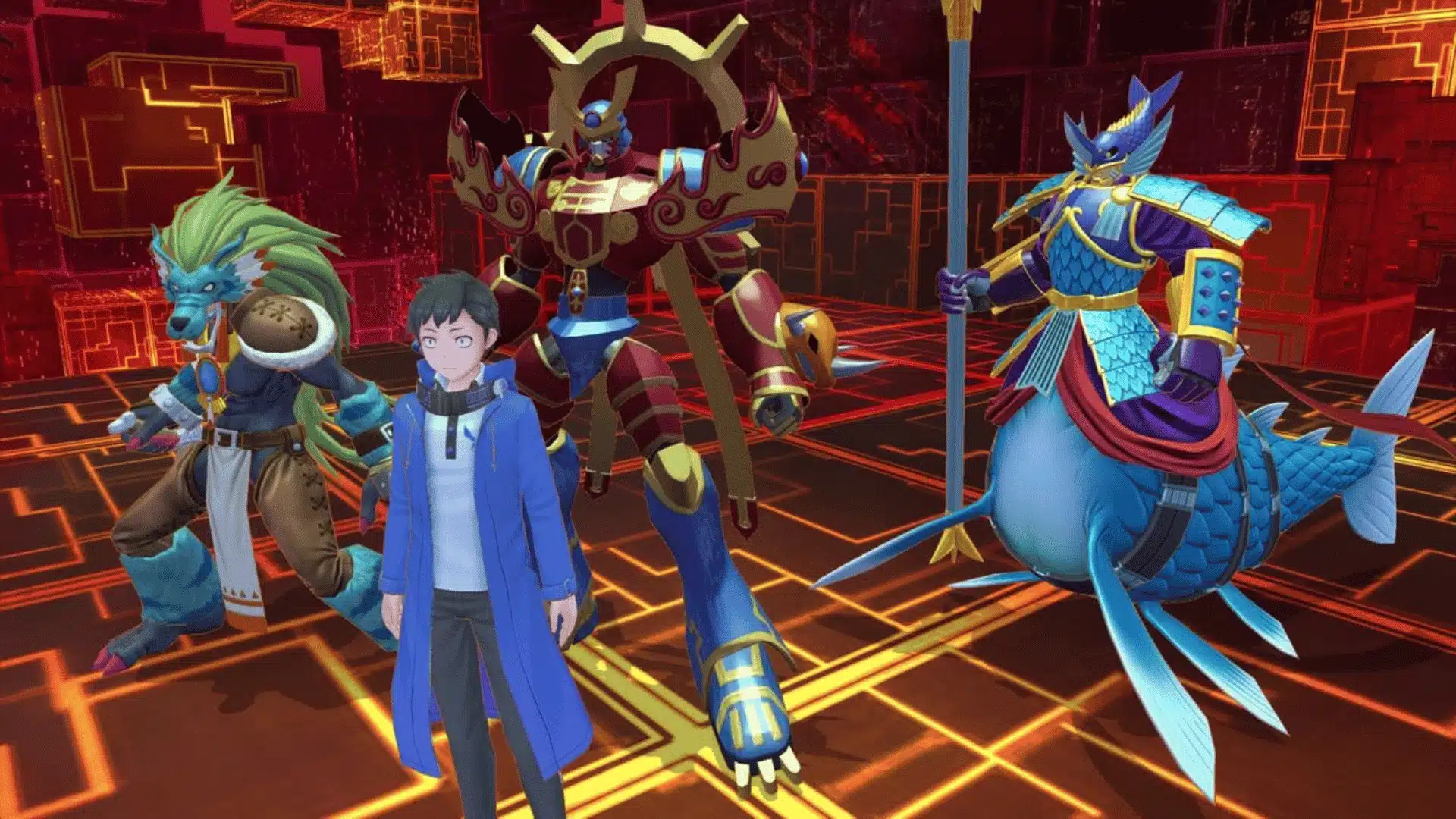
Yes, and it holds up well past the point where a monster-collecting RPG usually loses my attention.
The reason it works is not vague: the game runs two narrative layers at once, and that structure is what separates it from most titles in this genre.
Grounded real-world detective cases run alongside an escalating conspiracy inside EDEN. The cases are not filler; they build genuine stakes before the bigger threats arrive.
What the Main Story Gets Right?
I was surprised by how quickly the main mystery got its hooks in. It steadily raises the stakes, and each new layer connects back to something you already care about.
Newcomers do not need any Digimon background to follow it. The game builds its own world from hour one and never assumes you have watched the anime.
Here’s what it consistently gets right:
- Dual narrative structure: Detective cases ground the story in the real world before EDEN’s larger threats take over.
- Escalating stakes: Each case pushes the main conspiracy forward instead of feeling like a detour from it.
- No franchise knowledge needed: The game establishes its own rules within the first hour.
- Restrained tone: It handles serious themes without tipping into melodrama or talking down to the player.
The Persona and Shin Megami Tensei comparisons get thrown around a lot. The cyberpunk setting and monster mechanics make that an easy reach, but it only holds up on the surface.
Cyber Sleuth does not chase the same philosophical density, and it stays in its own lane instead.
If you want to see how much further a similar setup can push that idea, our Metaphor: ReFantazio review breaks down a title that leans much harder into that territory.
That focus is a big part of why the Cyber Sleuth story holds together as well as it does.
Where the Story Loses Its Footing?
The main arc is strong, but the space around it is not always. I hit my first real wall during the mid-game, when a stretch of long exposition scenes arrived back-to-back with no way to skip them.
It did not kill the experience, but it did test my patience more than once. These are the friction points that came up most often:
- Unskippable dialogue: Long scenes with no fast-forward option slow the pacing at the worst moments.
- Side-quest padding: Most side quests add runtime without adding anything meaningful to the world or characters.
- Slow mid-game stretch: The story loses momentum between major plot beats, making the gaps feel wider than they should.
- Repetitive scene structure: Some exchanges take twice as long as needed to land a point you saw coming early.
None of these individually would be a dealbreaker. Together, they create noticeable dead air around an otherwise well-constructed main story.
The core narrative is worth pushing through. Just go in knowing the slower stretches are part of the package.
Gameplay and the Digivolution System: How It Actually Works?
Digivolution in Cyber Sleuth is not a straight line from weak to strong. You evolve a Digimon into a higher form, then deliberately de-evolve it back to build stronger foundations.
Here is why that matters. When you De-Digivolve, your Digimon drops back to a lower form but keeps the CAM (Camaraderie) gains earned in the higher form.
Those gains permanently raise its base stats. Re-Digivolving after that gives you a stronger version of the same higher form than you had before.
The loop is intentional. The game is designed around it, not despite it.
1. The Digivolution and De-Digivolution Loop
Most players I have seen complain about difficulty spikes made the same mistake I did. They evolved forward and never looked back.
De-Digivolution feels like a loss of progress, but it is actually the intended path to stronger Digimon.
The full loop is: evolve to a higher form, build CAM, de-evolve to carry those stat gains back down, then re-evolve with a stronger base.
Running that cycle multiple times is how your team scales properly into the late game.
2. Combat: Turn-Based Structure and Team Building
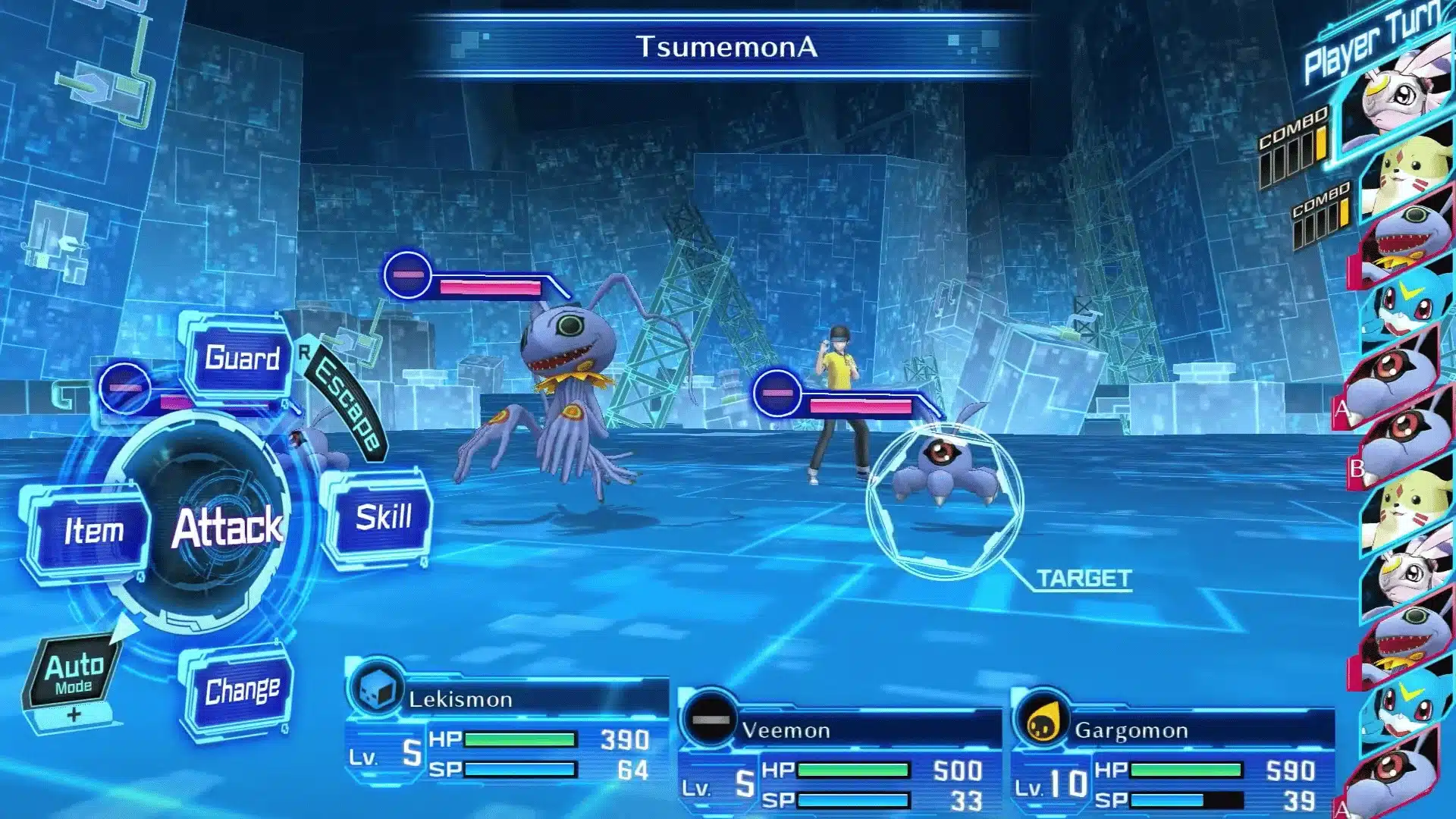
Three Digimon fight at a time, chosen from a broader roster you build and rotate. Type affinities matter. Data, Vaccine, and Virus types form a triangle that shapes every matchup.
Here’s how the triangle actually plays out.
Data beats Vaccine, Vaccine beats Virus, and Virus beats Data, with Free types sitting outside the cycle and never holding a type advantage or disadvantage.
Hit a Digimon with its weak type, and you land bonus damage; get hit on your weak side, and you take it instead.
Building a team with all three types covered means you are rarely caught without a counter, which matters more in boss fights than in regular encounters.
If you generally enjoy games built around type triangles and deliberate team building, our best turn-based RPGs roundup covers other titles that reward the same kind of planning.
Status effects add another layer on top of that. Players unfamiliar with monster-catching JRPGs will find the combat accessible. The depth is opt-in and not required to finish the story.
3. The Digifarm
Running the De-Digivolution loop on one Digimon at a time would take forever, which is where the Digifarm comes in.
You send them in, they gain stats and CAM over time, and you pull them out stronger without grinding battles manually.
I underused it early on and felt the gap later. It is especially important for the De-Digivolution loop. Keeping CAM building on multiple Digimon simultaneously is what makes roster depth manageable.
The systems here reward curiosity over brute force. Once the De-Digivolution loop clicked for me, the whole game opened up in ways I did not expect.
Dungeon Design: The Game’s Weakest System

The dungeons are the one area where I kept noticing the seams. Maps are small, visually recycled, and reused throughout the campaign with little variation.
You’ll walk the same handful of corridor layouts in different EDEN zones with little more than a palette swap separating them.
The world-building in the story is genuinely ambitious. The dungeon design never matches it. The environments feel like a budget constraint the game never found a way around, and after twenty hours, that repetition becomes hard to ignore.
The systems here reward curiosity over brute force. Once the De-Digivolution loop clicked for me, the whole game opened up in ways I did not expect.
Hacker’s Memory: Does the Second Game Justify Its Length?

I assumed Hacker’s Memory would feel like bonus content, something lighter to round out the package.
It is not. It is a full second game, roughly equal in length to the base game, and that changes how you have to think about it.
The question worth asking is not whether it is good. It is whether it earns that length given what it shares with the game you just finished.
What’s Different in Hacker’s Memory?
You play as Keisuke Amazawa, falsely accused of hacking, and try to clear his name through an underground hacker team.
The framing shifts from detective work to something closer to an outsider finding his place.
Start with the base game. Hacker’s Memory references its events in ways that land harder if you already know what happened.
Here is what actually changes between the two:
- Protagonist: Different character, different motivation, different relationships throughout.
- Story framing: Hacker community focus rather than detective casework.
- Supporting cast: An entirely new group of characters around the new lead.
- Digimon roster: Expands beyond what the base game offers.
The systems and EDEN environments stay the same. That consistency is both the selling point and the problem.
The Reused Environment Problem
This is the honest part. You will spend another 30-plus hours inside maps you already know by memory. The environments are not refreshed; they are the same spaces reused across a full-length campaign.
I felt it around the halfway point. These are the specific ways it shows:
- Same map layouts: No new areas introduced to break up the familiarity.
- Same visual design: Nothing is reskinned or rebuilt for the second game.
- Same dungeon structure: The recycling that bothered you in the base game continues here.
The world-building that made EDEN feel interesting the first time does not stretch far enough to cover a second full run through the same corridors.
Is Digimon Story: Cyber Sleuth Worth Playing?

Yes, Digimon Story: Cyber Sleuth is worth playing, and the Complete Edition is the version to buy.
I have watched people love it, and others drop it early. The difference almost never came down to the game itself; it came down to fit.
The difficulty complaints worth addressing first. Players who hit walls mid-game almost always ignored the De-Digivolution loop. I did the same thing early on.
The design is not broken. The game just never explains that system clearly enough, and players pay for that gap without knowing why.
Here is how it sits across three different player types:
- Systems-first JRPG player: Strong recommendation. The Digivolution mechanics reward the time you invest. Weak dungeon design is real but does not undercut the system’s depth.
- Story-driven player: Moderate recommendation. The main arc earns its ending, but the slow mid-game stretches and unskippable dialogue are genuine friction points worth noting.
- Low tolerance for grind or repetition: Honest caution. Recycled environments run through both campaigns without improving. That pattern stays present from the opening hours to the final stretch.
One thing I wish someone had told me earlier: play on Hard difficulty. Standard lets you ignore the depth entirely, and that makes the experience noticeably flatter.
The Complete Edition is the only version worth buying. Two full campaigns, one price, and nothing left out of the package.
If portable monster-collecting RPGs are generally your thing, our best Pokémon games on Switch list covers other titles that travel just as well.
Who Should Play It (and Who Can Skip It)?
Hacker’s Memory is worth playing if you finished the base game and want more.
The story covers different thematic ground: identity, belonging, what community means in online spaces, and the Digimon roster expands meaningfully.
First-time Digimon players are fine starting with the base game. Hacker’s Memory rewards players already comfortable with the systems. Here is a simple way to decide:
- Play it if: You enjoyed the base game’s systems and want another full campaign in the same world.
- Skip it if: The base game’s slower stretches already tested your patience; more of the same will not fix that.
- Don’t start here: The story assumes familiarity with base game events, and the impact is weaker without that context.
If you skip it, you lose nothing narratively. If you play it, go in knowing exactly what you are returning to.
Conclusion
This Digimon Story: Cyber Sleuth review comes down to patience and payoff.
The story takes time to build, the dungeons repeat too often, and the game does not explain its best systems as clearly as it should.
Still, once the Digivolution loop clicks, team building becomes much more rewarding than it first appears.
The Complete Edition is the smartest choice because it gives you two full campaigns and the strongest value. Don’t judge it by the first few hours alone. Start on Hard, use the Digifarm early, and let the systems open up.
Which Digimon would you build your first team around? Tell us in the comments below.
Frequently Asked Questions
Is Digimon Story: Cyber Sleuth Like Pokémon?
Not really, despite the surface similarity. You do collect and evolve Digimon, but combat plays closer to a Shin Megami Tensei-style turn-based RPG, and the story leans into a detective mystery rather than a straightforward adventure. Newcomers expecting a Pokémon clone are usually surprised by how different the pacing and tone actually feel.
Do I Need to Know Digimon to Enjoy Cyber Sleuth?
No prior knowledge is needed. Digimon Story: Cyber Sleuth builds its own world from the opening hour and never assumes familiarity with the anime or earlier games. The story, characters, and mechanics are explained clearly enough that a first-time player and a longtime fan start from roughly the same place.
Is Digimon Cyber Sleuth Worth Playing Today?
Yes. The Digivolution systems still hold up, and the dual-narrative story still lands years after release. The Complete Edition regularly goes on deep discount on Steam and Switch, which makes the two campaigns an easy value pick if you already enjoy turn-based JRPGs.
How Long Does It Take to Finish the Complete Edition?
Expect roughly 35 to 50 hours for the base game and a similar runtime for Hacker’s Memory. Completionists who chase every Digimon and side case report closer to 80 to 100 hours combined, so budget accordingly if you plan to play both campaigns back to back.
Should I Play on Normal or Hard Difficulty?
Hard is the better starting choice. It makes the Digivolution and De-Digivolution loop feel necessary rather than optional, which is where most of the game’s real depth actually lives. Normal difficulty lets you skip that system entirely, and the experience feels noticeably flatter as a result.