
One bad losing streak in Valorant can make your rank feel worse than it really is. That is why looking at the wider ladder helps more than judging yourself by one match.
The Valorant rank distribution shows where most players sit, which tiers are crowded, and how rare the highest ranks actually are.
Silver and Gold hold a large share of the player base, while Diamond, Ascendant, Immortal, and Radiant shrink fast.
You will see the current rank spread, what your percentile means, and how to read your own progress more clearly. Before judging your badge, let us first look at the current Valorant rank distribution.
What is the Current Valorant Rank Distribution?
The current ranked population is concentrated in the middle tiers, with far fewer players reaching the highest levels. Here is the Valorant rank distribution by tier for the current V26 Act 4 window:
- Iron: 4.43%
- Bronze: 13.28%
- Silver: 18.60%
- Gold: 22.41%
- Platinum: 19.66%
- Diamond: 13.16%
- Ascendant: 6.96%
- Immortal: 1.47%
- Radiant: 0.03%
These figures are approximate and pulled from tracker snapshots taken in the current act, not an official Riot census, so treat them as a close read on the shape of the ladder rather than an exact count.
Silver, Bronze, and Gold are still the three most crowded tiers between them. The median rank is Silver III, meaning half of ranked players are positioned at or below that level.
Reaching Diamond already places you ahead of most active competitors, while Ascendant marks an even smaller group.
Immortal and Radiant contain roughly 1.5% of players combined, with Radiant alone sitting at around 0.05% of the ranked population since it is a leaderboard seat rather than a fixed percentage tier
Why Does the Rank Distribution Look Like This?
The distribution is not random. Valorant’s matchmaking system is designed to group most players around an average skill level, which naturally creates a bell-shaped curve.
Silver and Gold are not necessarily easier ranks. They simply contain more players because the ranking system places the largest share of the population near its center.
Population density shapes the rank curve, not the actual difficulty of each tier. A crowded middle means many players have similar aim, game sense, movement, and decision-making skills.
It does not mean those ranks require little effort. Above Diamond, the player count drops quickly because fewer competitors can maintain the consistency needed to keep climbing.
Matchmaking also has a smaller pool of similarly skilled players available at higher levels. As a result, Ascendant, Immortal, and Radiant become progressively narrower and more selective.
If you are grinding toward one of those higher tiers, small performance edges start to matter more.
Dialing in your mouse polling rate settings is not holding you back, but it is the kind of unglamorous fixes that separate consistent Diamond players from the crowd below them.
What Does Your Rank Percentile Actually Mean?
Your visible rank does not always reflect your true skill level. Behind it sits MMR, or Matchmaking Rating, which influences who you face and how much Rank Rating you gain or lose after each match.
Your rank percentile shows how many ranked players you currently sit above, not your exact hidden MMR or long-term skill level.
For example, reaching Diamond may place you ahead of most active players, but two Diamond players can still have very different MMR scores.
When your MMR is higher than your visible rank, wins usually award more points and losses remove fewer. When it is lower, climbing becomes slower. This difference is especially noticeable around Platinum and Diamond.
Percentile data can also look distorted after rank resets, since placement matches temporarily shift players downward before the distribution settles again.
Riot runs a rank reset at the start of each new episode and a softer reset between acts, so do not panic if your badge dips right after one hits.
Valorant Rank Distribution by Skill Tier Grouping
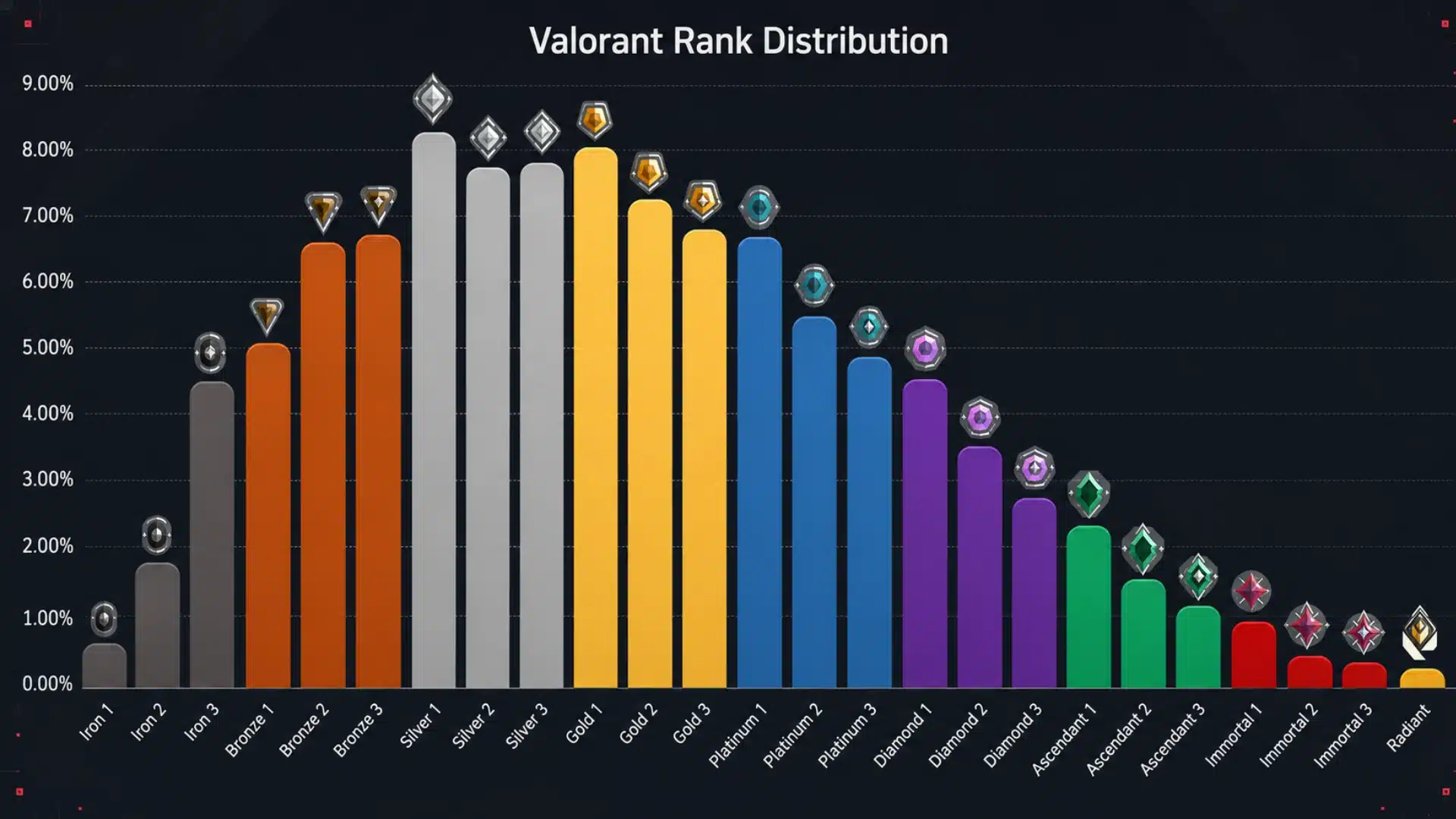
Source: vstats.gg
Grouping the 9 Valorant ranks into three wider skill bands makes the overall distribution easier to understand:
- Lower tiers, Iron to Silver: About 48% of players fall here. Positioning, utility timing, and basic decision-making often matter more than advanced mechanics.
- Mid tiers, Gold to Diamond: Roughly 45% of players compete in this range, making it the largest and most crowded section of ranked play.
- Upper tiers, Ascendant to Radiant: Around 6.5% of players reach these ranks. Consistency, teamwork, and dependable performance usually separate them from Diamond players.
Looking at rank groups gives a clearer sense of progress than comparing individual tiers alone.
Moving from Silver to Gold causes only a modest percentile change, while climbing from Diamond into Ascendant places you within a much smaller section of the competitive player base.
How to Read Your Own Rank Against These Numbers?
Rank distribution becomes useful only when you compare it with your own position. Start by finding your current tier in the list above, then use that percentage to estimate how much of the active player base you rank above.
Treat the result as a rough percentile rather than an exact measurement, since regional servers and platforms can show small differences in player spread.
It is also better to track your MMR trend than focus only on the badge beside your name. A visible rank can stay unchanged for several matches even while your hidden rating improves.
When that happens, the system may begin awarding more RR for wins and removing less for losses. That steady shift is often a stronger sign of progress than a single promotion.
Compare yourself with the wider player base, but judge improvement through consistency, MMR movement, and match performance.
If your aim and decision-making already feel ahead of your rank, watching how a pro allocates their crosshair placement and utility can highlight the gap faster than solo queue alone.
Studying a pro player’s Valorant settings is a quick way to see what separates a controlled Diamond game from a chaotic Silver one.
Conclusion
The Valorant rank distribution is useful because it turns your badge into context instead of pressure.
Silver and Gold being crowded does not make them easy, and reaching Diamond or higher already places you ahead of most ranked players.
I would use these numbers to track progress, not to judge every win or loss too harshly. Your MMR trend, decision making, aim control, and consistency tell a better story than one promotion screen.
Rank still matters, but it works best as a checkpoint, not a final label.
Where do you sit right now, and does your rank feel accurate compared with your matches? Tell us, share with us in comments below.
Frequently Asked Questions
What is the median rank in Valorant?
The median Valorant rank is Silver III to Gold 1, meaning half of all ranked players sit at or below this tier. Most players are concentrated between Silver and Platinum, with participation dropping sharply above Diamond. Reaching Diamond already places a player ahead of the majority of the active ranked population.
What percentage of Valorant players reach Immortal or Radiant?
Combined, Immortal and Radiant make up a small fraction of the ranked population, roughly 1.5% or less depending on the current act. Radiant itself is a leaderboard-based seat reserved for the very top of each region, not a fixed percentage tier like the others.
Why do so many players sit in Silver and Gold?
Matchmaking is built to cluster the bulk of players near an average skill point, which naturally produces the widest bands in the middle tiers. This isn’t a sign those ranks are easier; it simply reflects where population density is highest under the current matchmaking design.
Does rank distribution reset with each act?
Rank distribution shifts somewhat each act due to rank resets and updated placement matches, but the overall shape stays consistent. Early in an act, distribution figures can look temporarily skewed until players settle back into their true tier.